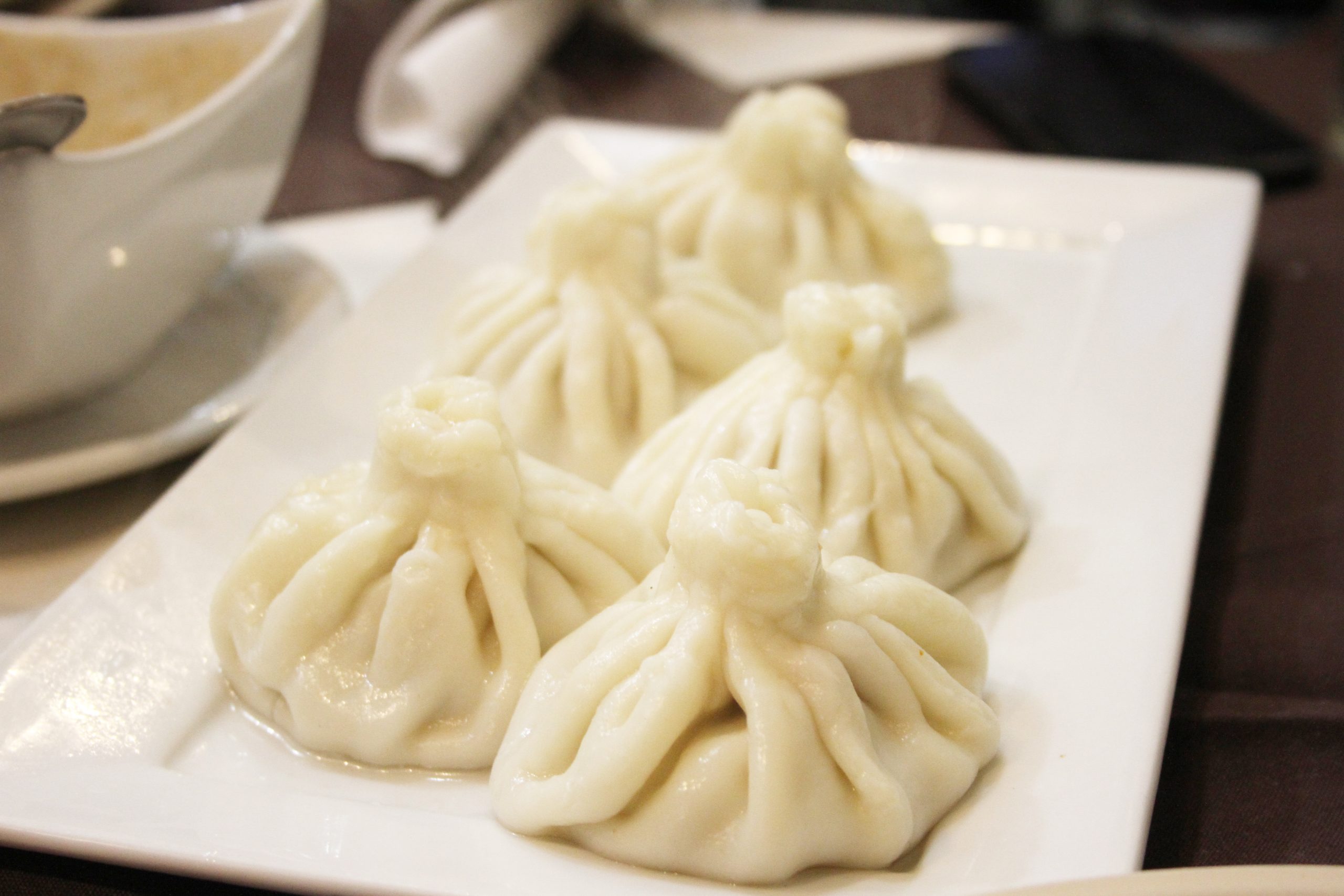
Khinkali are Georgia’s great dumplings: fat, hand-pleated knots of dough filled with spiced meat and, more importantly, a mouthful of hot broth that forms as they cook. Eating one is a small ritual. You hold the twisted topknot, bite a little opening in the side, sip out the scalding broth before it escapes, then eat the rest. Get it wrong and you wear the soup. Get it right and you understand why Georgians are so proud of them. Making them takes practice, and the practice is part of the fun.
From the Mountains
Khinkali come from the mountain regions of the Greater Caucasus, in eastern Georgia, where they were shepherd food before they became a national obsession. From those origins spread two main styles. Mtiuluri, the older mountain version, uses coarsely ground meat and leans on black pepper. Kalakuri, meaning city style, comes from Tbilisi and uses finely minced meat with herbs. Today khinkali houses, called sakhinkle, specialize in them, and Tbilisi families make trips to the villages around Mtskheta to eat them in their home region. They are ordered by the number, not the plate.
The Broth Is Built In
The defining feature of khinkali is the broth inside, and it is not added as liquid but created. You mix cold water, or cold broth, into the raw meat filling until it is loose and wet, almost sloppy. As the dumplings boil, the meat cooks and releases its juices, and that added water turns to the hot soup that pools inside the sealed dough. This is why the filling looks alarmingly wet when you spoon it in; that wetness is the whole point. A dry, firm filling makes a dumpling with no broth, which misses the entire idea.
The Dough
Khinkali dough is firm and unenriched, just flour, water, and salt, kneaded until smooth and rested so it rolls out without fighting back. It needs strength, because it has to hold both a wet filling and a pool of broth through a hard boil without tearing or leaking. Roll it thin, but leave the center of each round slightly thicker to support the weight of the filling, while keeping the edges thin so the many pleats do not build into a tough knot. The dough is the container, and a weak or thick one ruins the dumpling.
The Pleating
This is the hard part and the beautiful one. Set a spoon of the wet filling in the center of a dough round, then lift the edges and fold them into pleats, working around the circle and gathering all the folds up toward a single point at the top. A well-made khinkali has many pleats, sometimes twenty or more, meeting in a tight twisted knot. Pinch and twist that knot to seal it completely, because any gap lets the precious broth escape into the pot. Your first ones will have few pleats and look clumsy. Keep going; the hands learn.
Boiling
Khinkali boil in plenty of salted water, added a batch at a time so the pot stays lively and they do not stick together or crowd. Give the water a gentle stir as they go in to keep them moving off the bottom. They are done when they float and the dough at the topknot is fully cooked through, around eight to ten minutes depending on size. Lift them out with a slotted spoon and let them drain briefly. Do not overcrowd the pot, and do not let it boil so violently that the dumplings knock together and split.
Eating Khinkali
Serve them plain, dusted generously with coarse black pepper, which is the traditional and only seasoning they need at the table. The eating technique is fixed: pick one up by the topknot, bite a small hole in the side, and sip out the hot broth first before it spills. Then eat the rest of the dumpling in a bite or two. The thick, doughy topknot is left on the plate, uneaten; a pile of knots is how Georgians count how many you have had. Five to seven per person is a normal serving for a good appetite.
Common Questions
Why do you leave the topknot?
The gathered knot is thick, doughy, and undercooked compared to the rest, so it is traditionally left on the plate. The pile of leftover knots also serves as a tally of how many khinkali each person ate.
Can I freeze them?
Yes. Freeze the shaped raw khinkali on a floured tray until solid, then bag them. Boil straight from frozen, adding a few minutes. This is the practical way to handle a big batch, since folding them is the slow part.
What fillings are traditional besides meat?
The classic is spiced beef and pork, or beef alone. Other traditional fillings include cheese, potato, and mushroom, and in some places mixed meats with more herbs. The broth-forming technique changes with each filling.
Khinkali are Georgia's soup dumplings, born in the mountain regions of the Greater Caucasus and now eaten across the country, their spiced meat and broth held inside a thick, twisted knot of dough.