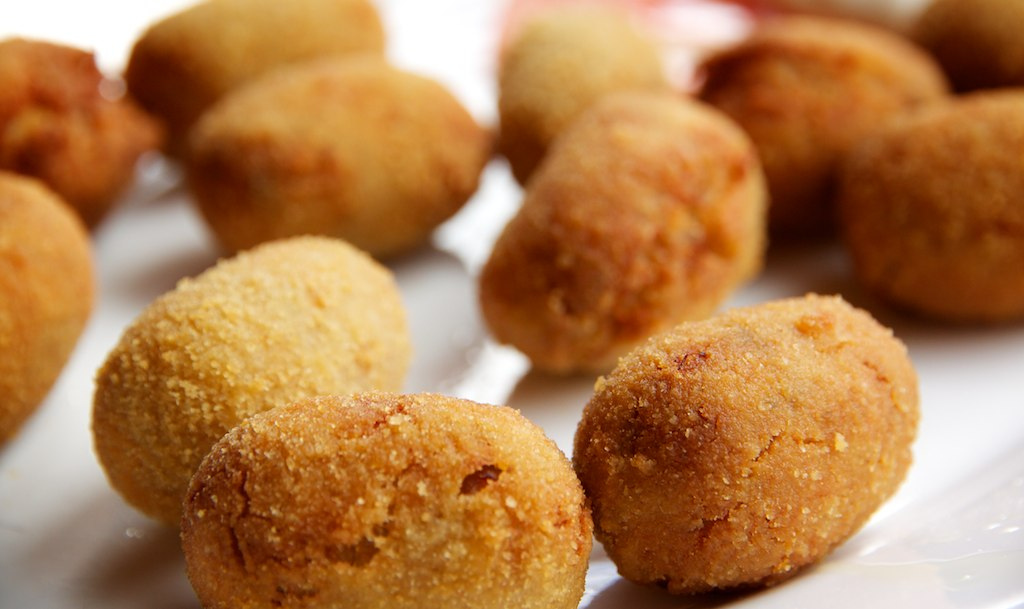
Croquetas are Spain’s favorite tapa for a reason: a crisp, deeply golden breadcrumb shell gives way to a molten, creamy center of bechamel laced with savory ham. Done right, the contrast is glorious. They ask patience rather than skill, since the bechamel must chill for hours before it can be shaped and fried, but every step is simple. Make a batch, and you understand why Spain has entire bars, croqueterias, devoted to nothing else, and why arguments over whose grandmother makes the best ones never end.
A French Idea, Perfected in Spain
The croquette began in France, where the classic filling is potato-based, and the name comes from croquer, to crunch. Spain took the idea in the nineteenth century and changed the heart of it: Spanish croquetas are built on thick bechamel rather than potato, which is what gives them their signature creamy, flowing center. They also became a dish of thrift, a delicious home for leftover ham, chicken, or fish folded into the white sauce. Today they are a fixture of tapas and pintxo bars everywhere in Spain, with croquetas de jamon, made with Spanish ham, the undisputed classic.
The Bechamel Base
The center of a croqueta is a bechamel cooked much thicker than sauce. Sweat the minced onion with the chopped ham in butter so the fat takes on the ham’s flavor, then stir in the flour and cook it for a few minutes to lose its raw taste. Whisk in warm milk gradually, and keep cooking and stirring until the mixture is very thick, smooth, and pulls away from the pan sides, seasoned with nutmeg and restrained salt, since the ham brings its own. This is the step to be patient with: an undercooked, loose bechamel makes croquetas that cannot hold themselves together.
The Chill Is Not Optional
Spread the finished bechamel into a dish, press plastic wrap directly onto its surface so no skin forms, and refrigerate it for at least four hours, better overnight. This chill firms the dough so it can be shaped, breaded, and fried without collapsing, and skipping or shortening it is the single most common croqueta failure. The rhythm suits home cooking well: make the base one evening, shape and fry the next. The firm dough also freezes beautifully at the shaped, breaded stage, which is how Spanish households keep a croqueta reserve for unannounced guests.
Shaping and Breading
With lightly oiled hands, portion the cold dough and roll it into small logs, the classic shape, or neat balls, keeping them modest in size so they heat through before the crust overbrowns. Then bread each one three times: a pass through flour, a dip in beaten egg, and a roll in breadcrumbs, pressing so the coat adheres everywhere with no bare patches, since any gap becomes a leak in the fryer. For an extra-sturdy shell, repeat the egg and crumb layers. Line the breaded croquetas on a tray without touching, and chill them again briefly while the oil heats.
Frying
Fry the croquetas in clean oil at a steady 350 F, in small batches so the temperature holds, turning them until they are a deep, even gold on all sides, a few minutes per batch. Too-cool oil soaks them and encourages splitting; too-hot oil browns the crust before the center warms. Drain them briefly on a rack or paper and salt lightly while hot. The goal inside is a center that has just melted back toward its saucy origins, so the first bite stretches and flows. Let them sit two minutes before serving, purely to spare the roof of your mouth.
Serving Croquetas
Serve croquetas hot, piled on a plate as a tapa with a cold beer or a glass of wine, as a starter, or alongside a salad as a light meal. In Spain they appear at every family gathering and every tapas crawl, eaten by hand and gone in two bites. Beyond jamon, the same base welcomes shredded chicken, flaked salt cod, sauteed mushrooms, or spinach and cheese, so one technique yields a whole repertoire. Breaded croquetas freeze for months and fry straight from frozen at a slightly lower temperature, which makes a double batch the only sensible batch.
Common Questions
Why did my croquetas burst in the oil?
The dough was too warm or loose, the breading had gaps, or the oil was too cool. Chill the bechamel thoroughly, coat every surface completely, and fry small batches at a steady 350 F. Each fix removes one cause.
Can I bake or air-fry them?
An air fryer or hot oven crisps them acceptably with a spray of oil, though the crust is lighter and less even than fried. The creamy center behaves the same. For the true tapas-bar result, shallow or deep frying wins.
What ham should I use?
Jamon serrano is the classic, chopped fine so it seasons every bite. Prosciutto or any good dry-cured ham substitutes well, and even leftover cooked ham makes fine croquetas. Salty cured ham means salting the bechamel with a light hand.
Croquetas grew from the French croquette, adapted in Spain with a bechamel base instead of potato; the ham version, croquetas de jamon, is a fixture of tapas bars across the country.