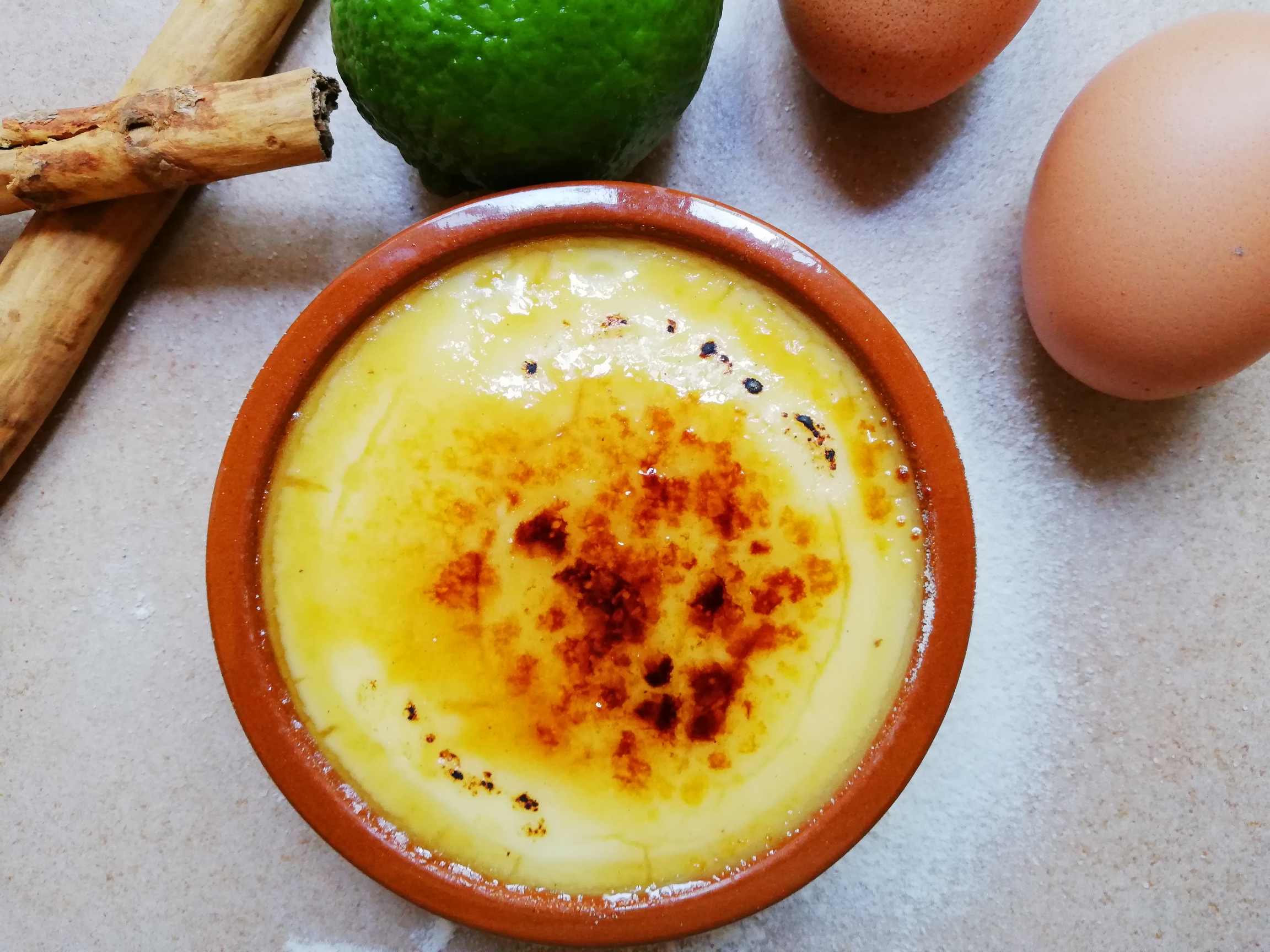
Crema catalana is a shallow dish of soft yellow custard, perfumed with lemon peel and cinnamon, topped with a thin sheet of burnt sugar that cracks under a spoon. It looks like creme brulee and tastes nothing like it: this is a milk custard rather than a cream one, thickened on the stovetop and set in the fridge, lighter on the palate and far more citrus-forward. It is Catalonia’s most famous dessert and one of the oldest in Spain.
An Old Catalan Dessert
Crema catalana comes from Catalonia and its origins reach back at least to the eighteenth century, which makes it one of the oldest desserts still eaten regularly in Spain. It is also known as crema de Sant Josep, since it is traditionally eaten on Saint Joseph’s Day in March. The comparison with French creme brulee is unavoidable and both countries claim priority, but the two are made differently enough that the argument matters less than it appears. What is not in doubt is that the Catalan version is built on milk, egg yolks, and citrus rather than cream and vanilla.
Milk, Not Cream
The defining difference is the dairy. Crema catalana uses whole milk, giving a custard that is lighter and cleaner on the palate than the heavy cream base of creme brulee, and it is thickened with cornstarch on the stovetop rather than baked slowly in a water bath. That makes it considerably faster and more forgiving to make at home, since there is no oven, no bain-marie, and no anxious checking for the right wobble. The tradeoff is that it needs constant attention on the heat, because starch thickens quickly and unevenly if left alone.
Lemon and Cinnamon
The flavor is citrus and spice rather than vanilla. Warm the milk with a cinnamon stick and wide strips of lemon peel, often with orange peel too, then take it off the heat and leave it to steep for twenty minutes or longer so the oils release properly. Use a peeler and take only the colored zest, avoiding the bitter white pith underneath. Strain the peel and cinnamon out before the milk meets the eggs. This infusion is the entire personality of the dessert, so give it real time rather than rushing it.
Thickening the Custard
Whisk the yolks with sugar and cornstarch until pale and smooth, then pour the warm infused milk into them slowly while whisking, which brings the eggs up to temperature without scrambling them. Return everything to the pan over gentle heat and stir constantly, reaching into the corners, until the custard thickens enough to coat a spoon heavily. Take it off the heat the moment it does. If lumps appear, pass it through a sieve immediately, which rescues almost any batch. Pour it into shallow earthenware dishes, the traditional vessel, and chill for several hours.
The Burnt Sugar
Traditionally the sugar top is caramelized with a hot iron disc pressed onto the surface, a tool still sold in Catalonia specifically for this dessert, though a kitchen torch does the same job. Sprinkle an even, thin layer of sugar over each chilled custard and burn it until it melts and darkens, tilting the dish so the sugar spreads. Because the custard underneath is cold and set rather than warm, the contrast between the cool cream and the hot brittle crust is sharper than in creme brulee. Do this at the last possible moment, since the crust softens within minutes.
Serving Crema Catalana
Serve it cold, in the shallow dishes it set in, with the sugar still crackling. Traditional wide earthenware cazuelas give the best ratio of caramel to custard, since the point is a large surface of burnt sugar over a thin layer of cream. It appears on almost every Catalan restaurant menu and at family tables on Saint Joseph’s Day. The custard can be made a day or two ahead and kept covered in the fridge, which makes it an easy dessert for guests, with only the sugar left to burn at the table.
Common Questions
How is it different from creme brulee?
Crema catalana uses milk thickened with cornstarch on the stovetop and is flavored with citrus peel and cinnamon. Creme brulee uses cream, is baked in a water bath, and is usually flavored with vanilla. The Catalan version is lighter and served fully chilled.
Can I make it without a blowtorch?
Yes. The traditional tool is a hot iron disc pressed onto the sugar, sold in Catalonia for this purpose. A broiler works too, set very high with the dishes close to the element, watching constantly so the sugar burns without warming the custard.
Why did my custard turn lumpy?
The heat was too high or the milk went into the eggs too fast. Temper the eggs by adding the warm milk gradually while whisking, cook gently while stirring constantly, and pass the finished custard through a sieve if any lumps appear.
Crema catalana is a Catalan custard dessert flavored with citrus zest and cinnamon and finished with a layer of caramelized sugar; its origins go back at least to the 18th century.