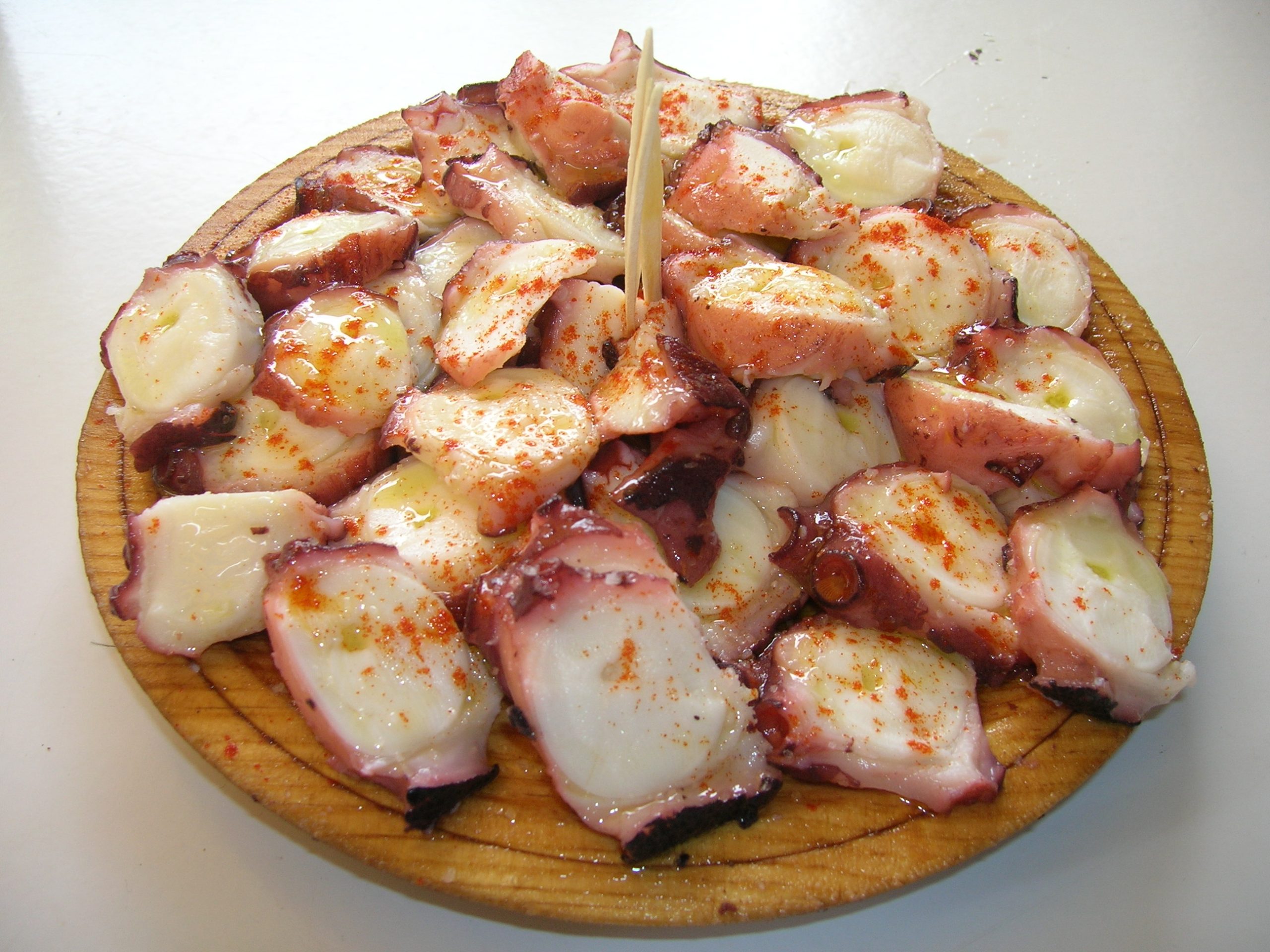
Pulpo a la gallega is octopus at its simplest and best: boiled until tender, cut into thick coins with a pair of scissors, laid over slices of soft potato, and dressed with nothing more than good olive oil, coarse salt, and a heavy dusting of smoked paprika. Traditionally it arrives on a round wooden plate and is eaten with toothpicks. There are five ingredients and no sauce to hide behind, which means the entire dish rests on cooking the octopus correctly.
The Dish of the Fairs
In Galician the dish is called polbo a feira, fair-style octopus, and the name records exactly where it comes from: the rural fairs and religious festivals of inland Galicia, where octopus was cooked in huge copper pots and sold to the crowds. Octopus travelled inland well because it was dried for preservation, which is why the provinces of Ourense and Lugo, far from the coast, became known for cooking it. It remains the signature food of the San Froilan festivities in Lugo. The cooks who specialize in it are called polbeiras, traditionally women, and their rustic eateries are still found across the region.
Tenderizing
Octopus muscle is tough and needs breaking down before it will ever turn tender. The old method was physical: beating the octopus repeatedly against a rock or a stone wall at the harbor. The modern equivalent is the freezer, and freezing does the same work by rupturing the muscle fibers as ice crystals form. Buy octopus already frozen, which most is, or freeze fresh octopus for a few days and thaw it slowly in the fridge before cooking. Skipping this step is the single most common reason home-cooked octopus turns out rubbery no matter how long it simmers.
The Three Dips
Galician cooks perform a small ritual before the octopus goes in to cook. Holding it by the head, they lower it into the boiling water and lift it out again three times, waiting a few seconds between each dip, and only then leave it in the pot. The explanation given is that this sets the skin and keeps the tentacles from curling and shedding, and whether or not the science holds, it is universal practice in Galicia. Add an onion and a bay leaf to the water; salt goes in only at the end, since salting the cooking water is said to toughen the flesh.
Judging Doneness
Timing is the whole difficulty, since octopus goes from tough to tender to mushy with no obvious signal. A rough guide is around twenty minutes per kilo, but weight varies and so does the animal, so test rather than trust the clock. Push a skewer or thin knife into the thickest part of a tentacle where it joins the head: it should slide in with only slight resistance. Then take the pot off the heat and let the octopus rest in its own cooking water for fifteen minutes or so, which lets it relax and finish gently.
Potatoes and Dressing
The potatoes, called cachelos in Galicia, are boiled in the octopus water so they take on its flavor, then sliced into thick rounds and laid across the plate as a base. Cut the tentacles into thick coins with scissors rather than a knife, which is how it is done in Galicia and gives cleaner pieces. Then dress: a generous pour of good extra virgin olive oil, coarse sea salt, and pimenton de la Vera, the smoked Spanish paprika, usually a mix of sweet and hot. The paprika is not a garnish but the defining flavor, so use plenty and use the real Spanish kind.
Serving Pulpo a la Gallega
Serve it warm on a wooden plate if you have one, which is traditional and keeps the heat, with toothpicks rather than cutlery and plenty of bread for the oil. It works as a tapa in the middle of a table or as a proper first course. The classic pairing is a cold glass of Albarino or Ribeiro, both Galician whites with enough acidity to cut the oil. Resist the urge to add garnishes, lemon, or sauces; the restraint is the point, and the dish has survived unchanged for a reason.
Common Questions
How do I keep octopus from turning rubbery?
Freeze it before cooking, which breaks down the muscle fibers, and test with a skewer rather than relying on a timer. Then let it rest in the cooking water off the heat. Overcooking past tender makes it mushy instead, so check often near the end.
Can I use frozen or pre-cooked octopus?
Frozen is preferred, since freezing tenderizes it. Vacuum-packed pre-cooked octopus, sold at good fishmongers and Spanish shops, is a legitimate shortcut and only needs warming, slicing, and dressing with the oil, salt, and paprika.
What paprika should I use?
Pimenton de la Vera, the Spanish smoked paprika, in a mix of sweet and hot to taste. Ordinary paprika lacks the smoke that gives this dish its character, so it is worth buying the Spanish tin specifically for it.
Pulpo a la gallega, known in Galician as polbo a feira, takes its name from the rural fairs where it was traditionally cooked and eaten, and is dressed only with olive oil, salt, and paprika.