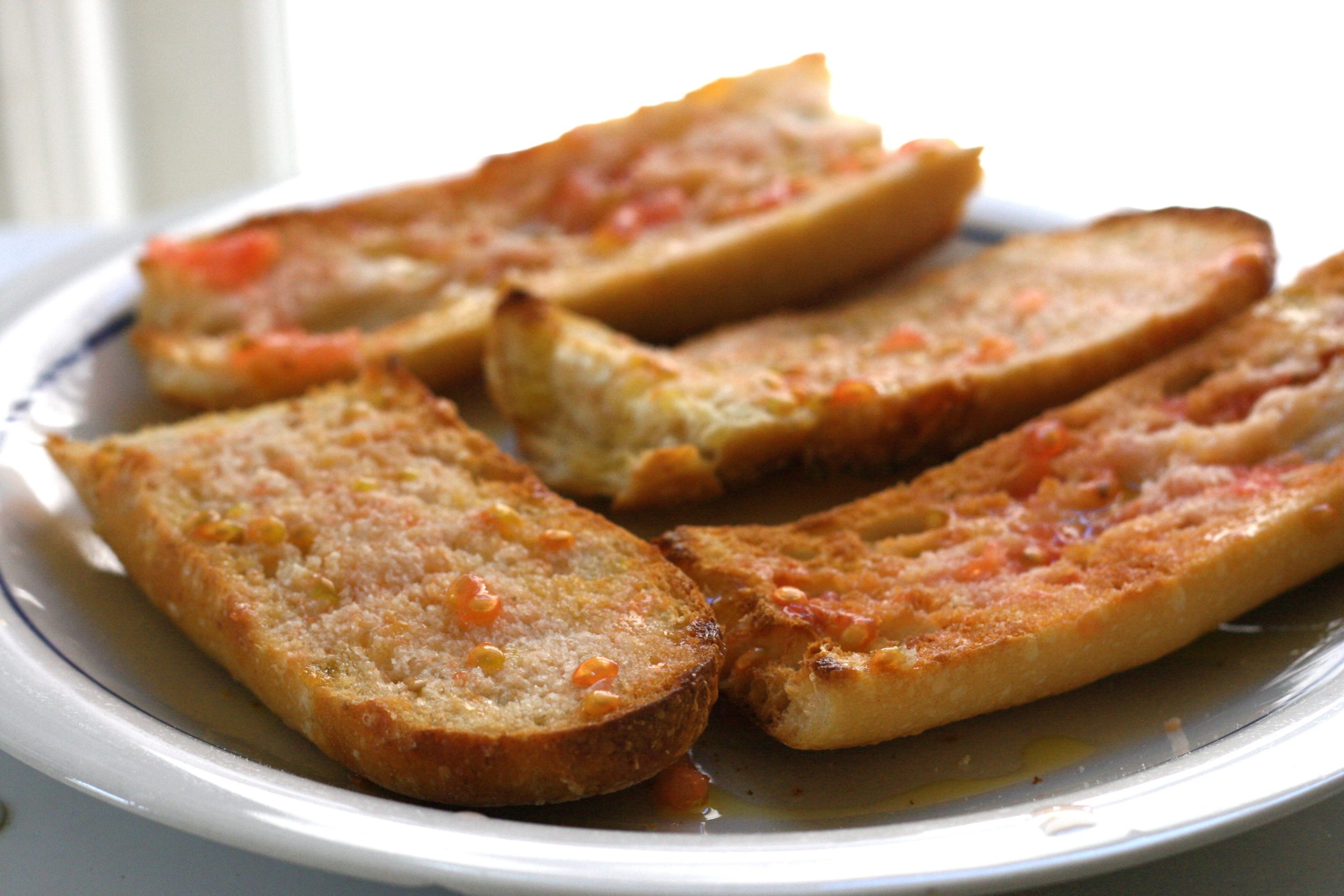
Pan con tomate is toasted bread rubbed with garlic and the cut face of a ripe tomato, then dressed with olive oil and coarse salt. That is the entire recipe. It arrives before almost every meal in Catalonia, holds up whole tapas menus, and turns a loaf of ordinary bread into something people talk about afterwards. There is no technique to master, only ingredients to get right, which is exactly why it is so easy to do badly and so satisfying when done well.
The Catalan Staple
In Catalonia the dish is pa amb tomaquet, and it is treated as something close to a symbol of the region’s cooking and identity. Its history is less settled than its status suggests: tomatoes only reached Europe from the Americas after the fifteenth century, so the dish cannot be ancient. One Catalan chef documents it in the eighteenth century, while other accounts place its spread along the Spanish Mediterranean coast as recently as the mid to late nineteenth century. In Catalonia it accompanies lunch and dinner as a side; further south in Andalusia the same combination is more often a breakfast.
The Bread
Use a rustic country loaf with an open crumb and a firm crust, sliced thickly, or a split baguette. The bread has to be sturdy enough to survive being rubbed with garlic and tomato without tearing or collapsing into pulp, which rules out soft sandwich bread. Slightly stale bread is traditional and works better than fresh, since day-old bread absorbs the tomato juice and oil without disintegrating. Toast or grill it until golden and firm all the way through; a grill or a grill pan adds a little char that suits the dish well.
Garlic, Lightly
Cut a clove in half and rub the cut face across the hot toast, once or twice and no more. The heat of the bread releases the garlic oil, and the rough toasted surface acts like a grater, so a small amount goes a long way. This step is where the dish most often goes wrong at home, since heavy-handed garlic overwhelms the tomato and olive oil entirely. Some Catalan households leave it out altogether, particularly when serving it to children or alongside delicate ingredients, and rubbing garlic on only half the slices is a reasonable compromise.
Rubbing or Grating
The traditional Catalan method is to halve a ripe tomato and rub the cut face hard across the toast, pressing so the pulp and juice soak into the surface while the skin stays in your hand and is discarded. This gives the thinnest, most integrated coating. The alternative, common in Andalusia and in restaurants, is to grate the tomatoes on the large holes of a box grater into a bowl, leaving the skins behind, then spoon that pulp over the bread. Grating gives a thicker, more generous layer, and both approaches are entirely legitimate.
Oil and Salt
Finish with a proper pour of extra virgin olive oil, more than seems reasonable, and a scatter of flaky sea salt. With so few components, the oil is a main ingredient rather than a dressing, so this is the moment for a bottle you would happily taste on its own. Salt goes on at the very end so it stays crunchy against the soft tomato. Assemble everything immediately before eating, because tomato-soaked toast turns limp within minutes and the contrast between crisp bread and juicy pulp is the whole appeal.
Serving Pan con Tomate
Serve it plain as a side to almost anything, or top it to build a meal: jamon serrano or iberico is the classic partner, along with manchego, anchovies, tinned tuna, or a slice of tortilla. It sits at the start of a tapas spread and goes with everything that follows. For a group, set out toasted bread, halved tomatoes, garlic, oil, and salt and let people build their own, which is how it is often done at Catalan tables and keeps every slice at its best.
Common Questions
Should I rub or grate the tomato?
Rubbing the cut half directly onto the toast is the traditional Catalan method and gives a thin, integrated coating. Grating the tomatoes and spooning the pulp over gives a thicker layer and is common in Andalusia and in restaurants. Both are correct.
What tomatoes work best?
Very ripe, juicy ones with soft flesh, since they are doing most of the work. In Catalonia a small ripening variety called tomaquet de penjar is used. Out of season, the dish suffers, so save it for tomatoes that actually taste of something.
Can I make it ahead?
No. The bread softens within minutes of meeting the tomato, and crispness is central to the dish. Toast the bread and grate the tomatoes in advance if you like, but combine everything only as you sit down to eat.
Pan con tomate, known in Catalan as pa amb tomaquet, is bread rubbed with tomato, garlic, olive oil, and salt; it is regarded as a symbol of Catalan cooking, though its exact origin is disputed.