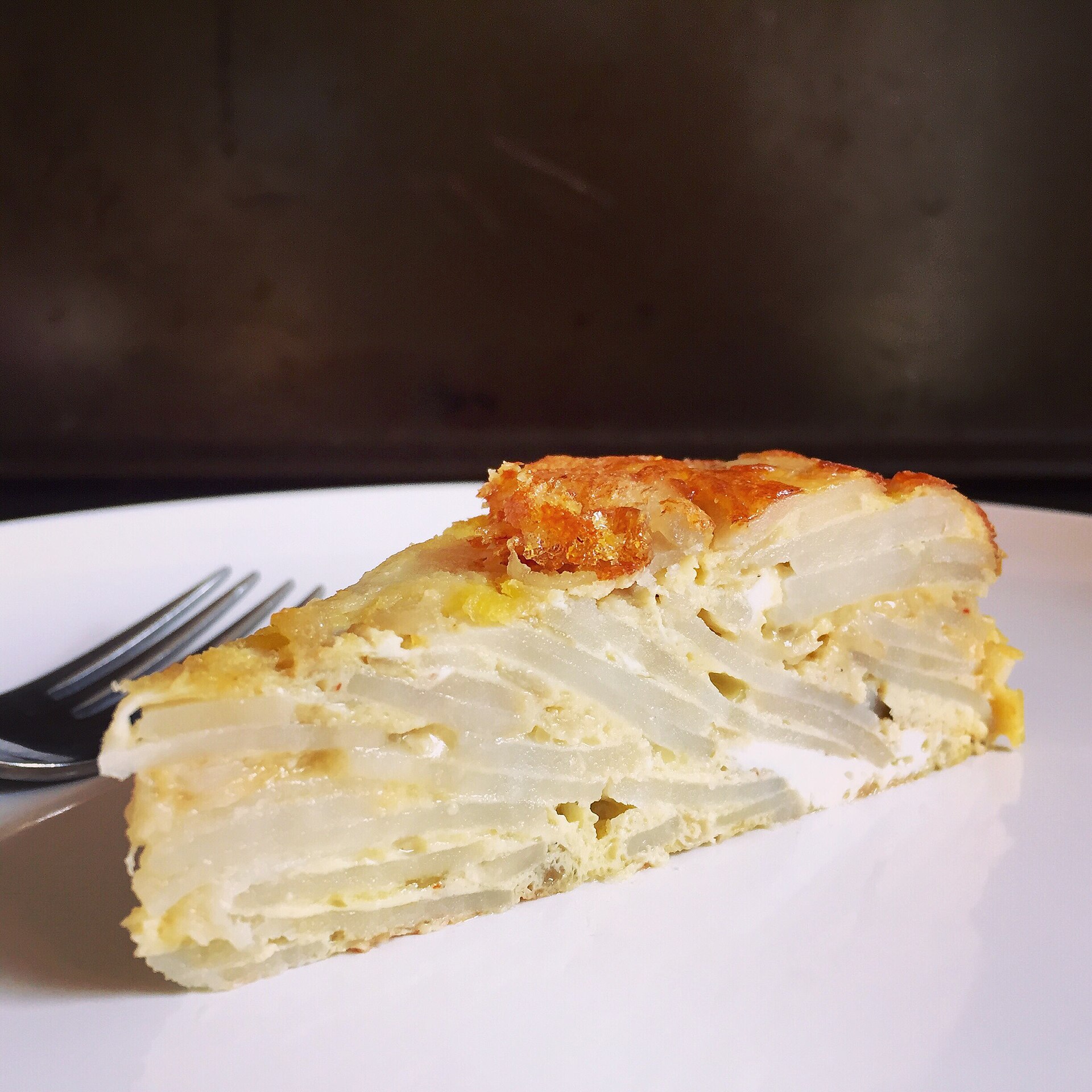
The Spanish tortilla is one of those dishes that proves how far a few humble ingredients can go. Potatoes, eggs, olive oil, and salt become a thick, tender omelet that Spaniards eat at all hours: as a tapa on a slice of bread, as a light dinner, cut into cubes at a party, or packed cold for a picnic. It is simple food done with care. The potatoes are cooked slowly until soft, the eggs bind everything, and the only real challenge is the flip. Master that and it is yours.
Spain’s Everyday Omelet
Tortilla de patatas, also called tortilla espanola, is arguably the most genuinely everyday dish in Spain, found in nearly every home, bar, and cafe. Note that here tortilla means a thick egg omelet, not the flatbread of Mexico. It dates to the nineteenth century as an affordable, filling meal of cheap, available ingredients, and it never left. It is served hot or cold, whole or in wedges, on its own or on bread as a pintxo. Its constancy across the whole country, from the coasts to the north, makes it a true national staple.
Cooking the Potatoes
The soul of a good tortilla is in how the potatoes are cooked. They are sliced thin and cooked gently in a generous amount of olive oil over low heat until they are soft and tender, almost confit, rather than fried crisp and brown. This slow, oily cooking, poaching really, gives the potatoes the melting texture that makes the tortilla. Do not rush it with high heat; you want soft, not crunchy. Drain them well afterward, saving the flavorful oil for other cooking. Season them with salt while warm. Well-cooked potatoes are the difference between a great tortilla and a dry one.
The Onion Debate
There is a genuine, long-running argument in Spain over whether a tortilla should contain onion. The con onion camp says softened onion adds sweetness and moisture; the sin onion purists say potatoes and eggs alone are the true version. Both are widely made and defended with real feeling. This recipe leaves it optional, so make it as you like. If you use onion, slice it thin and cook it down slowly with the potatoes until soft and sweet. Whichever side you land on, it is a real debate in Spanish kitchens, not a small detail.
Binding With Egg
Beat the eggs, then stir the warm, drained potatoes into them and let the mixture sit for a few minutes. This resting step lets the potatoes absorb some of the egg and warms the eggs slightly, which helps the tortilla cook evenly and hold together. The ratio of egg to potato is generous on potato; this is a potato omelet, not an egg one padded with potato. The mixture should look full of potato bound by just enough egg. Season it and make sure it is well salted, since potatoes and eggs both need it.
The Flip
Cooking the first side is easy; flipping the tortilla to cook the second is the moment of truth. Cook the mixture in a nonstick pan over medium-low heat until the bottom and sides set but the top is still loose. Then take a flat plate larger than the pan, set it over the top, and confidently invert the whole thing onto the plate. Slide the tortilla back into the pan, uncooked side down, and cook the second side briefly. Keep the center slightly soft and moist, which is how Spaniards prefer it, not dry all the way through. Nerve helps at the flip.
Serving It
A Spanish tortilla is served hot, warm, or at room temperature, which is part of why it is so useful. Cut it into wedges as a light meal with a salad, into small cubes speared with toothpicks as a party snack, or set a slice on bread as a tapa or pintxo. It travels well and holds up for hours, making it ideal picnic and lunchbox food. It keeps two or three days refrigerated and is good cold from the fridge. Let it rest a few minutes after cooking so it settles before you cut it.
Common Questions
Onion or no onion?
Both are traditional and hotly debated in Spain. Onion adds sweetness and moisture; leaving it out gives a purer potato-and-egg flavor. Make it whichever way you prefer; neither is wrong, though people hold strong opinions.
How do I flip it without a disaster?
Use a flat plate wider than the pan. Set it over the pan, invert the tortilla onto the plate in one confident motion, then slide it back to cook the other side. A good nonstick pan helps. Speed and commitment matter more than finesse.
Should the center be runny?
Slightly soft and moist in the center is the preferred texture in much of Spain, not fully dry or raw. Cook it to your comfort with egg doneness, but a completely dry tortilla is considered overcooked by many Spaniards.
The Spanish tortilla, or tortilla de patatas, is a thick omelet of potatoes and eggs cooked in olive oil, a staple across Spain served as a tapa, a light meal, or picnic food.