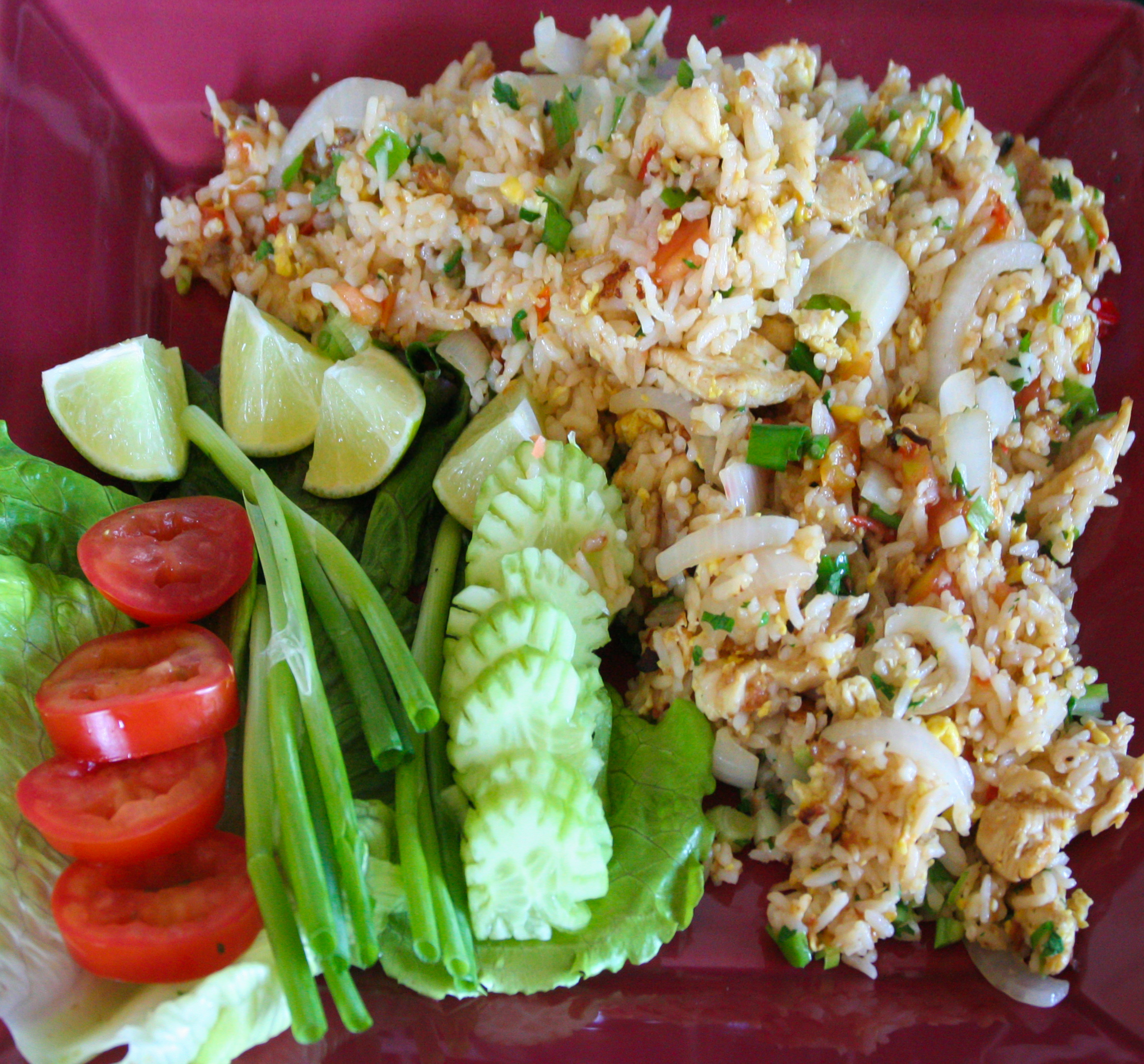
Khao pad is what Thailand does with yesterday’s rice: cold jasmine rice broken up by hand and thrown into a searing wok with garlic, egg, a little meat, and a splash of fish sauce, then tossed until every grain is separate and coated. It arrives with a wedge of lime and a dish of chili fish sauce, and those two things are as much a part of it as anything in the pan. It takes ten minutes, uses whatever is in the fridge, and is sold on every street corner in the country.
Rice From Yesterday
Khao pad means fried rice, and it exists in Thailand for the same practical reason fried rice exists everywhere: leftover rice needs using. Versions are named for what goes in, so khao pad gai is the chicken one, khao pad goong the shrimp, khao pad moo the pork. It is found at every street stall, every restaurant, and every home kitchen, eaten at any hour including breakfast. What distinguishes it from Chinese fried rice is not the technique, which is shared, but the seasoning, and specifically the presence of fish sauce alongside soy.
The Rice
Jasmine rice cooked the day before and refrigerated overnight is the only correct starting point. As cooked rice cools, its starch firms and the grains dry out on the surface, which is exactly what lets them fry and separate instead of clumping. Freshly cooked rice carries too much moisture and turns into a sticky mass in the wok no matter how hot the pan. Break the cold rice apart with your hands before cooking, crushing every clump, so it goes into the wok as loose grains. In a hurry, spread fresh rice on a tray and chill it uncovered.
Fish Sauce and Soy
The seasoning is where khao pad becomes Thai. Fish sauce and light soy sauce work together to produce a depth that neither reaches alone, with the fish sauce adding a savory complexity that registers without announcing itself as its own flavor. A little sugar balances the salt and white pepper adds a gentle warmth that black pepper does not replicate. Keep the seasoning restrained overall, since Thai fried rice is not meant to be dark or heavily sauced, and the lime and chili condiment at the table do the final adjusting.
Heat and Order
Get the wok very hot before anything goes in and work in a set order: meat first to sear, then garlic and onion, then the eggs scrambled in a cleared space, then the rice. Press the rice against the hot surface of the wok and let it sit for a few seconds at a time between tosses, which fries the grains rather than steaming them and gives a faintly toasted flavor. Cook one or two portions at a time at most, because a crowded wok drops in temperature immediately and the rice ends up soft and pale.
Additions
Thai fried rice is deliberately sparse compared with heavily loaded versions elsewhere. Onion, tomato wedges, and scallions are the usual vegetables, with tomato added near the end so it softens without collapsing. Chinese kale, peas, or carrot appear in some versions. Chicken, shrimp, pork, crab, or Chinese sausage all work, cut small so they cook quickly. A fried egg on top is a common finish, as is a version made with the sweet-salty pork of khao pad moo. Keep the additions few, since the rice itself is the dish.
Serving Khao Pad
Serve it straight from the wok with wedges of lime, sliced cucumber, and a small dish of prik nam pla, the fish sauce with sliced Thai chilies and garlic that sits on every Thai table. The lime squeezed over the top is not a garnish but part of the dish, cutting through the savory rice and lifting everything. Eat it with a spoon and fork, the standard Thai way, pushing food onto the spoon with the fork. It is best fresh from the pan, so cook it to order rather than in advance.
Common Questions
Why does my fried rice turn out mushy?
The rice was too fresh or the wok too cool. Use rice cooked the day before and refrigerated, break up all the clumps by hand, and cook in small batches over the highest heat your stove produces.
What makes it different from Chinese fried rice?
The seasoning. Thai fried rice uses fish sauce alongside soy sauce, is usually lighter in color, and is served with lime and chili fish sauce on the side. Jasmine rice and the tomato and scallion additions are also characteristic.
What is prik nam pla?
Fish sauce with sliced Thai chilies, garlic, and often a squeeze of lime, served in a small dish on Thai tables. Spooned over fried rice or almost anything else, it adds salt and heat at the eater’s own discretion.
Khao pad is Thai fried rice, made from day-old jasmine rice stir-fried with egg, garlic, and vegetables and seasoned with both soy sauce and fish sauce, which distinguishes it from other fried rice traditions.