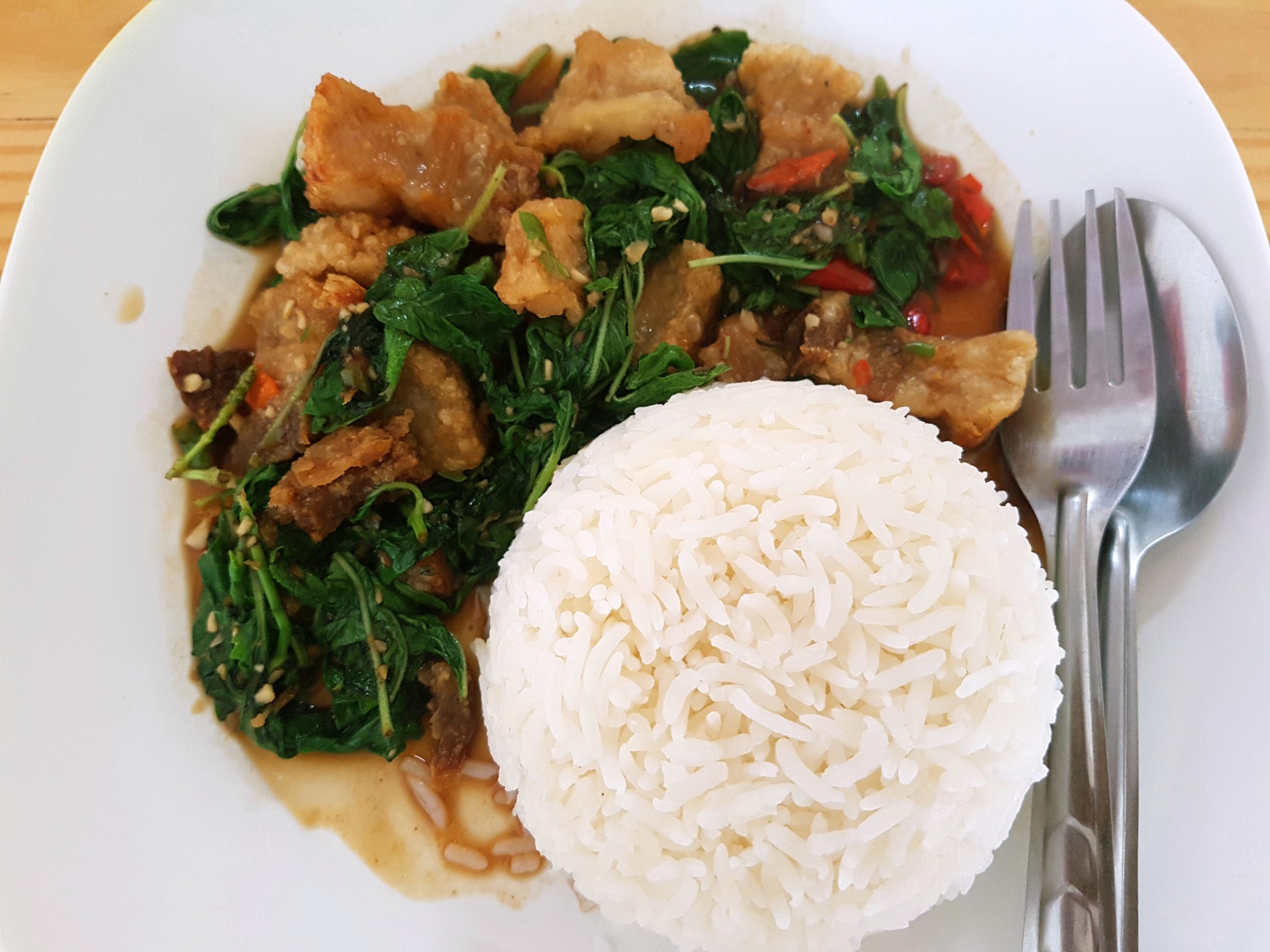
Pad krapow is the dish Thai people crave when they get home from abroad, and it is easy to see why: minced meat stir-fried hard with garlic, chili, and holy basil, spooned over jasmine rice, and crowned with a crispy fried egg whose runny yolk melts into the spicy meat. It is fast, fiery, and endlessly satisfying, ready in the time it takes to cook rice. Truly a Thai fast food, it is on every street stall and in every home, and it belongs in your weeknight rotation.
Thailand’s Everyday Favorite
Pad krapow, meaning stir-fried holy basil, is one of the most popular dishes in Thailand, the reliable order at the tam sang stalls where cooks make whatever you ask over rice. It took shape in the twentieth century as wok cooking spread through Bangkok and workers wanted quick, cheap, energizing lunches, and it has been a national comfort food ever since. Some call it Thailand’s true national dish. The name points to its defining ingredient, holy basil, and the standard version pairs minced meat with a fried egg over rice, known as pad krapow moo rat khao when made with pork.
Holy Basil, the Namesake
The herb that names the dish is holy basil, bai krapow, and it is not the same as the Thai sweet basil used in curries or the Italian basil on pizza. Holy basil has a peppery, slightly bitter, almost clove-like bite that cuts through the rich, savory meat, and it is the signature flavor of the dish. It goes in at the very end, stirred through just until it wilts, so its aroma stays fresh and pungent. If you can find holy basil at a Thai or Asian market, use it; Thai sweet basil is the next best substitute, though the character shifts. This herb is what makes pad krapow itself.
The Meat and Aromatics
Minced pork is the classic choice, though chicken, beef, and even seafood or crumbled tofu all work. The aromatics are simple and pounded together: garlic and fresh Thai chilies, crushed into a rough paste in a mortar, which releases more flavor than chopping. The number of chilies sets the heat, and traditional pad krapow is genuinely spicy, so adjust to your tolerance. Fry the paste in hot oil until fragrant, then add the meat and stir-fry it hard, breaking it up and letting it brown a little for depth. Purists keep it to meat, garlic, chili, and basil, with no extra vegetables muddying the dish.
High Heat and Speed
Pad krapow is a stir-fry, and stir-fries live on high heat and speed. Get your wok or pan as hot as it goes before the oil and paste go in, and keep everything moving fast; the whole cook takes only a few minutes. The seasoning is a quick balance of oyster sauce, light soy for salt, a little dark soy for color, and a pinch of sugar, tossed through the meat. Then the holy basil goes in last, folded through the heat just until it wilts. Work quickly and do not let the pan cool, since a slow, crowded pan steams the meat instead of searing it.
The Crispy Fried Egg
The classic partner to pad krapow is kai dao, a Thai-style fried egg, and it is not an ordinary sunny-side up. It is fried in a generous amount of hot oil so the white puffs, blisters, and turns golden and crisp at the lacy edges while the yolk stays runny. Set on top of the meat and rice, the crisp egg adds texture and the soft yolk, broken over the plate, enriches and mellows the spice. Fry the eggs before the stir-fry so the meat is served hot. Ask for the yolk fully set if you prefer, but the runny yolk over spicy meat is the beloved combination.
Serving Pad Krapow
Serve pad krapow immediately, spooned over hot jasmine rice with the crispy egg on top. A small dish of prik nam pla, fish sauce with sliced chili, on the side is the traditional condiment, letting each eater add salt and heat, and a few slices of cucumber cool the palate. It is a single-plate meal, quick enough for a busy weeknight and satisfying enough to crave. Made with whatever minced meat is in the fridge, it is one of the most useful dishes to have in your repertoire, and it tastes like Thai street food the moment the basil hits the pan.
Common Questions
What if I cannot find holy basil?
Thai sweet basil is the closest substitute, though it is sweeter and less peppery than holy basil, so the dish changes character a little. It is still delicious. Look for holy basil (bai krapow) at Thai and Asian markets for the authentic flavor.
How spicy should it be?
Traditional pad krapow is quite spicy, but the heat is entirely up to you. Adjust the number of Thai chilies to taste, using one or two for mild and several for the real street-stall kick. The fried egg and rice help balance the heat.
Can I add vegetables?
Purists keep pad krapow to meat, garlic, chili, and basil, but some cooks add long beans, bell pepper, or onion. If you do, keep them minimal so the dish stays a quick, punchy stir-fry rather than a mixed vegetable plate.
Pad krapow, stir-fried holy basil, is one of Thailand's most popular everyday dishes, built on minced meat, garlic, chili, and holy basil, typically served over rice with a fried egg.