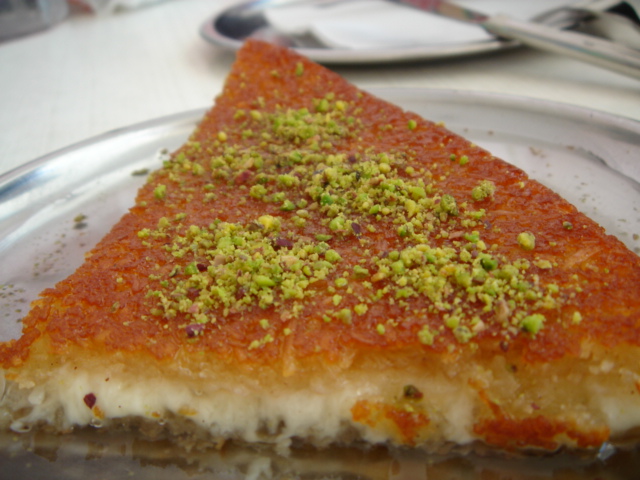
Künefe is one of the most spectacular desserts in Turkish cuisine: a nest of fine shredded pastry wrapped around a layer of melting cheese, baked until deep golden and crisp, drenched in syrup, and served hot so the cheese pulls into long, gooey strands. Sweet, buttery, crunchy, and molten all at once, and finished with a scatter of green pistachio, it is a showstopper. The technique has a few key rules, the right cheese, crisping both sides, and the essential cool-syrup-on-hot-pastry trick, but none is difficult.
A Hot Cheese Dessert
Künefe is a hot dessert built on kadayıf, the fine shredded pastry, layered around fresh unsalted cheese, and it is strongly associated with Hatay and the Antakya region of southern Turkey, though it is loved across the country. It belongs to a broader eastern Mediterranean family of shredded-pastry cheese sweets, shaped by the interplay of Middle Eastern and Ottoman kitchens, with close relatives across the region. What makes künefe unique among desserts is the melting cheese at its heart, which turns a sweet, syrupy pastry into something rich and stretchy. It is served hot, fresh from the pan, and eaten right away.
The Cheese Is Everything
The defining feature of künefe is the cheese, and choosing it right is the difference between success and disappointment. It must be an unsalted, fresh, stretchy cheese that melts into soft, gooey strands when heated, giving the signature pull when you lift a piece. In Turkey a special künefe cheese or fresh unsalted white cheese is used; outside Turkey, fresh mozzarella, drained well, or a mix with a mild fresh cheese comes closest. A salty or aged cheese will not melt into that stretchy layer and throws off the balance against the sweet syrup. Slice or shred the cheese so it spreads evenly between the pastry layers.
The Kadayıf
Kadayıf is the shredded pastry that looks like fine pale threads, sold at Turkish, Middle Eastern, and many international markets, sometimes labeled kataifi. Chop it into shorter lengths and toss it thoroughly with plenty of melted butter, working the butter through every strand, which is what lets it crisp and turn golden. Press half of it firmly into the bottom of the pan as a base, add the cheese, then top with the rest and press down again, so the kunefe holds together as a compact cake. The generous butter and firm pressing are what give künefe its crisp, cohesive texture rather than a loose, dry tangle.
Crisping Both Sides
Künefe needs to be crisp and golden on both sides, with the cheese fully melted between. Traditionally it is cooked in a shallow copper pan over low heat on the stovetop, letting the bottom slowly turn deep golden and crunchy, then carefully flipped to crisp the other side; a hot oven also works, or a combination. Low, patient heat is important so the pastry crisps and colors evenly while the cheese melts through, rather than burning outside before the middle softens. When both sides are a rich golden brown and the cheese is molten, it is ready, and the next step must happen immediately while it is piping hot.
The Syrup Rule
Here is the golden rule of künefe, and of many Turkish syrup pastries: pour cool syrup over hot pastry. Make the syrup first, from sugar, water, and a little lemon juice, and let it cool completely while the kunefe cooks. Then, the moment the hot künefe comes off the heat, pour the cool syrup evenly over it. The temperature contrast is what lets the pastry drink in the syrup while staying crisp; hot syrup on hot pastry, or letting it sit, turns everything soggy. The kunefe should sizzle as the syrup hits. Use just enough syrup to sweeten and moisten without drowning it.
Serving Kunefe
Serve künefe immediately, hot from the pan, scattered with finely ground pistachios and, if you like, a spoon of clotted cream (kaymak) on the side. The whole point is the moment when the pastry is crisp and the cheese is still molten and stretchy, so it cannot wait; it does not keep or reheat well, since the cheese firms and the crispness fades. Make it to order for guests and bring it straight to the table, where lifting the first piece and watching the cheese pull is part of the pleasure. A glass of Turkish tea alongside cuts the sweetness perfectly.
Common Questions
What cheese works for kunefe?
An unsalted, fresh, stretchy melting cheese. In Turkey a special künefe cheese is used; elsewhere, well-drained fresh mozzarella, or a mix with a mild fresh white cheese, comes closest. Avoid salty or aged cheeses, which will not melt into the signature gooey strands.
Why did my kunefe go soggy?
The syrup was too hot, or too much was used, or it sat too long. Always pour cool syrup over hot kunefe, use just enough to moisten, and serve at once. The temperature contrast is what keeps the pastry crisp.
Where do I find kadayıf?
Turkish, Middle Eastern, Greek, and many international markets sell it, often in the fridge or freezer, sometimes labeled kataifi. Toss it well with melted butter before using. It is the same shredded pastry used in several regional syrup desserts.
Künefe is a hot Turkish dessert of shredded kadayıf pastry layered around unsalted melting cheese, baked until crisp and golden, soaked in syrup, and topped with pistachio, associated with Hatay in the south.