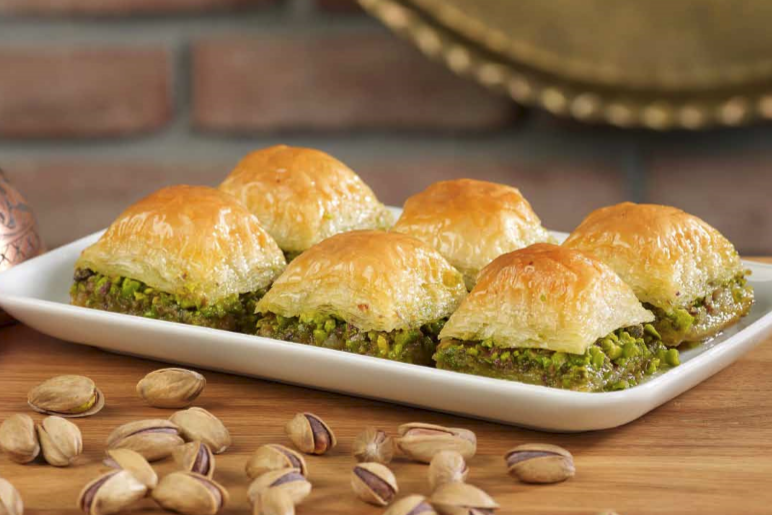
Baklava is the crown of Turkish sweets: dozens of paper-thin layers of filo pastry brushed with butter, packed with ground pistachios or walnuts, baked until golden and shatteringly crisp, then soaked in syrup. Each bite crackles and dissolves into buttery, nutty sweetness. It looks intimidating and takes patience, but the technique is a series of simple, repeated steps, and the two real secrets, buttering every layer and getting the syrup temperature right, are easy once you know them. Made well, homemade baklava is a genuine achievement worth the effort.
The Jewel of Turkish Desserts
Baklava is closely tied to Turkish and Ottoman cuisine, and the sophisticated layered pastry known today was developed in the imperial kitchens of the Ottoman palace, drawing on an older Central Asian tradition of layered breads. Its origins are debated and claimed across the wider region, since versions of baklava are found throughout the former Ottoman lands, the Middle East, and the Balkans. In Turkey the city of Gaziantep is famous above all for its pistachio baklava, made with the region’s prized green pistachios; Antep baklava holds European protected status. Master makers, ustas, spend years learning to roll the dough thin enough to read through.
The Filo
Baklava is built from filo, the tissue-thin pastry that bakes into crisp, flaky layers. Traditional makers roll their own yufka by hand, incredibly thin, but very good baklava can be made with quality store-bought filo, which saves enormous effort. The one challenge with filo is that it dries out and cracks fast once unwrapped, so keep the sheets you are not using covered with a damp towel while you work. Handle it gently, since it tears easily. Work steadily through the stack. Store-bought filo makes this dessert achievable at home; rolling your own is a craft that takes years to master.
Butter Every Layer
The single most important technique in baklava is brushing every single sheet of filo with melted butter as you layer it. This is not the place to cut corners. Those thin films of butter between the pastry sheets are exactly what bake into the flaky, crisp, shattering layers that define baklava; skimp on the butter and the layers turn dry and stuck together instead of crisp and separate. Use clarified butter if you can, since it browns less and gives a cleaner result. Layer several buttered sheets, add ground nuts, more buttered sheets, and so on, buttering as you go, patiently, one sheet at a time.
The Nuts
The filling is ground nuts, and in Turkey pistachios are the prized choice, especially the vivid green pistachios of Gaziantep, though walnuts are also traditional and common, and some regions use hazelnuts. Grind the nuts fairly fine but not to a powder, leaving a little texture. The nuts go in one or more layers between the sheets of filo. Good, fresh nuts matter, since they are a main flavor. A pistachio baklava is bright green inside and considered the finest; a walnut baklava is earthier and more everyday. Whichever you use, keep the nut layer generous enough to taste but not so thick it stops the layers crisping.
The Syrup Secret
The syrup is a simple boil of sugar, water, and a little lemon juice, but how you use it is the one trick that decides crisp versus soggy baklava. The rule is a temperature contrast: pour cool syrup over hot baklava, straight from the oven, or hot syrup over cooled baklava. If both are hot, the baklava goes soft and soggy. The contrast lets the syrup soak in while the pastry stays crisp. Also, cut the baklava into diamonds or squares before baking, all the way through, so the syrup can run down into every piece. Let it soak and cool fully before serving.
Serving Baklava
Serve baklava at room temperature, in the pieces you cut before baking, finished with a sprinkle of finely ground pistachios on top. It is rich and sweet, so small pieces go far. In Turkey it is served with tea or strong Turkish coffee, whose slight bitterness balances the sweetness, and sometimes with a scoop of kaymak, thick clotted cream, alongside. Baklava keeps well, up to a week or more at room temperature in a covered container, and does not need refrigeration, which would dry it out. Make it ahead for gatherings, since it holds beautifully and only needs cutting and serving.
Common Questions
Why did my baklava turn out soggy?
The syrup and pastry were both hot when combined. Pour cool syrup over hot baklava, or hot syrup over cooled baklava, never hot on hot. The temperature contrast lets it soak in while staying crisp. Buttering every layer also helps.
Pistachio or walnut?
Both are traditional. Pistachio, especially Gaziantep’s green pistachios, is prized and gives the famous bright green baklava. Walnut is earthier and very common. Use whichever you prefer, or the nut most associated with your favorite regional style.
Can I use store-bought filo?
Yes. Quality store-bought filo makes very good baklava and saves the difficult work of rolling paper-thin dough by hand. Keep the sheets covered with a damp towel as you work so they do not dry out and crack.
Baklava is a layered filo pastry with nuts and syrup whose modern form developed in Ottoman palace kitchens, with the pistachio baklava of Gaziantep among the most famous versions.