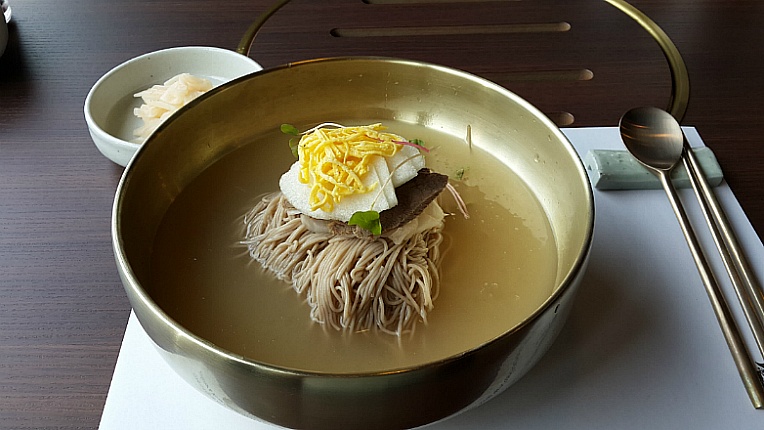
Naengmyeon is a bowl of very long, very chewy grey-brown noodles sitting in a broth so cold it carries ice crystals, topped with slices of beef, julienned pear and cucumber, and half a boiled egg. It is sharp, tart, faintly sweet, and shockingly refreshing on a hot day. There is nothing else quite like the texture of the noodles, which resist the teeth in a way that takes some getting used to and then becomes the reason people crave the dish.
A Northern Winter Dish
Naengmyeon is North Korean in origin, associated above all with Pyongyang and Hamhung, and it came south in large numbers with refugees during the Korean War, which is how it became a fixture of restaurants throughout South Korea. The historical detail that surprises people is the season: cold noodles were traditionally a winter dish, eaten in freezing weather using broth from dongchimi, the radish water kimchi fermented in cold months. Its transformation into the definitive Korean summer food came later, once refrigeration made icy broth available in July rather than January.
Mul and Bibim
Two versions share the name. Mul naengmyeon, the water version described here, serves the noodles in a large amount of chilled broth and is associated with Pyongyang. Bibim naengmyeon has almost no broth and instead tosses the noodles in a fiery gochujang-based sauce, and it is linked to Hamhung, where noodles made with potato or sweet potato starch give an even chewier texture. Restaurants usually offer both, and a common practice is to order one of each and pour a little broth from the first into the second partway through the meal.
The Noodles
Naengmyeon noodles are made from buckwheat flour combined with starch, most often potato or sweet potato, though arrowroot and kudzu versions exist too. That starch is what produces the extraordinary chew and elasticity, since buckwheat alone has no gluten to hold it together. They are sold dried or fresh at Korean markets. Boil them for only a couple of minutes, no longer, then rinse them under cold running water while rubbing them between your hands to wash away surface starch. That rinsing is what makes them cold, springy, and clean rather than sticky.
The Icy Broth
The broth is traditionally built from simmered beef brisket, sometimes with dongchimi brine mixed in for its natural sourness and fermented depth. Chill it thoroughly and skim the solidified fat off the top, then season it with vinegar, a little sugar, and salt until it tastes distinctly tart. The step that matters most is the freezer: put the broth in for an hour or two until ice crystals form through it, so it pours out slushy. Restaurants serve it in this half-frozen state, and a bowl of merely cool broth misses the whole character of the dish.
The Toppings
The arrangement is close to standard: thin slices of the boiled brisket, julienned Korean pear for sweetness and crunch, julienned cucumber, half a hard-boiled egg, and sometimes pickled radish. The pear matters more than it appears to, since its cold sweetness plays directly against the sour broth. At the table, Koreans add a little rice vinegar and a spoonful of Korean mustard oil, which is sharp and sinus-clearing, adjusting the balance to their own taste. Both are usually set on the table for people to add themselves rather than mixed in beforehand.
Eating Naengmyeon
Serve in a metal bowl if you have one, which stays colder longer, and bring scissors to the table. The noodles are extremely long and genuinely difficult to bite through, and cutting them into manageable lengths with scissors is normal practice in every naengmyeon restaurant in Korea rather than any kind of failure. It is a common companion to Korean barbecue, ordered at the end of a grilled meat meal to cut the richness, and it is eaten in enormous quantities through the hot months. Assemble it at the last moment and eat it immediately, since the noodles tighten and the broth loses its chill within a few minutes of being poured.
Common Questions
What is the difference between mul and bibim naengmyeon?
Mul naengmyeon serves the noodles in cold tart broth. Bibim naengmyeon has little or no broth and coats the noodles in a spicy gochujang sauce instead. The noodles are the same; the sauce and the amount of liquid are what change.
Why are the noodles so chewy?
They are made from buckwheat combined with potato or sweet potato starch, and that starch gives them their elasticity. Rinsing them hard in cold water after boiling tightens them further. Scissors at the table are standard for cutting them.
Can I make the broth without beef?
Yes. Dongchimi brine from radish water kimchi is a traditional base on its own, tart and refreshing without any meat. A vegetable stock seasoned with vinegar, a little sugar, and salt also works when a beef broth is not practical.
Naengmyeon is a noodle dish of North Korean origin made from long thin noodles of buckwheat and starch; the mul naengmyeon version is eaten mainly in summer today but was historically a winter dish.