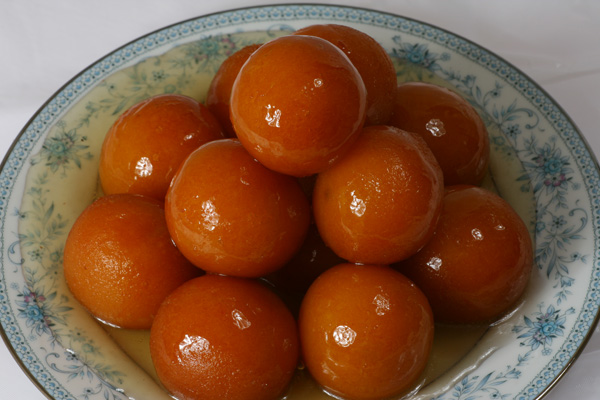
Gulab jamun is the sweet that ends Indian weddings, festivals, and family dinners: small dumplings of milk solids, fried slowly to a deep mahogany brown, then left to drink up a warm syrup scented with cardamom, saffron, and rose. Bite one and it collapses, soaked through and impossibly soft, releasing syrup as it goes. They are served warm, usually two to a bowl, and they disappear fast. The technique rewards patience over speed, particularly at the frying stage, where most home attempts go wrong.
Rose Water and the Jamun Fruit
The name is a compound that describes the sweet twice over. Gulab refers to rose, from the rose-scented syrup, and jamun is the dark purple Indian fruit that the finished dumplings resemble in size and color. The sweet emerged in medieval India during the Mughal period, blending Persianate influence with local traditions of cooking down milk. The thirteenth-century Arab dessert luqmat al-qadi looks similar and was also soaked in rose-scented syrup, though it is made from a completely different batter, so the shared element is the perfumed syrup rather than the dumpling itself. Regional cousins exist across the subcontinent, including the Malwa version known as mawa bati.
Khoya, the Milk Solids
Traditional gulab jamun begins with khoya, also called mawa, which is milk simmered down for hours until almost all the water evaporates and what remains is a dense, faintly sweet solid. This is what gives the dumplings their rich dairy flavor and tender crumb, and nothing else quite replicates it. Grate or crumble it, then knead it with a small amount of flour and a pinch of baking soda into a smooth, soft dough, adding a little milk only if it feels dry. Keep the flour to a minimum, since too much makes the finished sweets dense and chewy rather than melting.
Shaping the Balls
Roll the dough between your palms into balls that are perfectly smooth, with no cracks or seams anywhere on the surface. Cracks split open in the hot fat and let the dumpling fall apart, so keep rolling until the surface is flawless, greasing your palms lightly if the dough sticks. Make them small, roughly the size of a large marble, because they swell considerably during frying and then again as they soak up syrup. If the dough cracks no matter how you roll it, it is too dry, and a few drops of milk kneaded in will fix it.
Frying Low and Slow
This is where gulab jamun succeeds or fails. The ghee or oil must be only warm, not hot, when the balls go in, and the heat must stay low throughout. Hot fat browns the outside in seconds while the middle stays raw and doughy, which is exactly why homemade versions so often come out hard in the center. Slide the balls in gently and, instead of stirring them directly, swirl the pan or move the fat around them so they turn and color evenly on all sides. They should take several minutes to reach a deep, even brown.
The Syrup
The syrup is a simple sugar solution boiled just until slightly sticky, flavored with crushed green cardamom and a pinch of saffron, with rose water added at the end off the heat so its perfume survives. It should stay thin; a thick, one-string syrup will not soak into the dumplings properly. Keep it warm and slip the fried dumplings straight in while they are still hot, so they absorb steadily and swell. Then leave them alone for at least an hour, and preferably several, because the soaking is what transforms fried dough into gulab jamun.
Serving Gulab Jamun
Serve them warm, two or three per bowl with a spoonful of their syrup and a scatter of slivered pistachios or almonds. In India they appear at weddings, Diwali, Eid, and every celebration in between, and they are widely sold in sweet shops by the box. Warm gulab jamun with cold vanilla ice cream is a popular modern pairing that plays temperature against temperature. They keep several days in their syrup, refrigerated, and are reheated gently before serving. Do not skimp on the soaking time; a rushed gulab jamun is a dry one.
Common Questions
Why are my gulab jamun hard inside?
The fat was too hot, so the outside browned before the inside cooked, or the dough had too much flour. Fry on low heat in warm ghee for several minutes, and keep flour to a minimum so the dumplings stay soft and absorbent.
Can I use milk powder instead of khoya?
Yes, and many home cooks do. Full-fat milk powder mixed with a little flour, ghee, and milk makes a workable dough and a good result. Khoya gives the richest, most traditional flavor, but milk powder is far easier to find outside India.
Why did my dumplings break apart in the oil?
Cracks on the surface, too much baking soda, or fat that was too hot. Roll each ball until completely smooth, measure the soda carefully, and keep the frying gentle so the dumplings hold together while they cook through.
Gulab jamun is an Indian sweet of fried milk-solid dumplings soaked in sugar syrup that emerged in medieval India during the Mughal period, blending Persianate influence with local traditions.