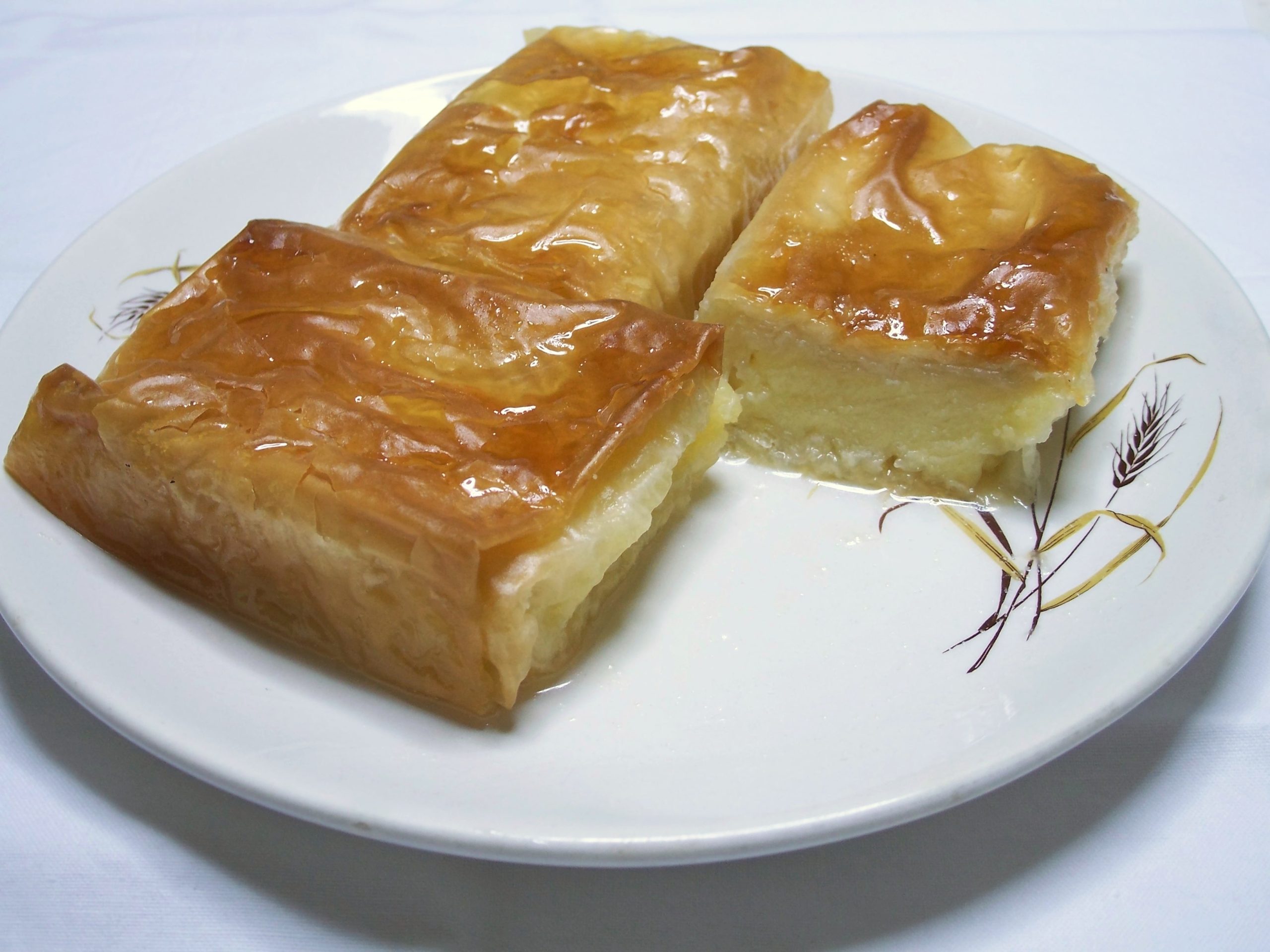
Galaktoboureko is the dessert that converts people who think they do not like custard: a thick, creamy semolina custard baked between crackling layers of buttered phyllo, then drenched in cold citrus syrup while still hot from the oven. The contrast is the whole point, crisp shattering pastry against soft cool cream, with the syrup binding it together. It is a fixture at Greek bakeries, weddings, and family celebrations, and while it takes a little organization, none of the steps is difficult.
Milk Pastry
The name galaktoboureko is a compound that describes the dessert exactly: galakto from the Greek for milk, joined with boureko, the pastry term related to borek, giving something like milk pastry. It belongs to the family of phyllo-and-syrup sweets that spread widely during the Ottoman period, and by tradition it is associated with the prosperous Greek communities of western Asia Minor, particularly Smyrna. A closely related dessert is made in the eastern Black Sea region of Turkey. Greeks had long made pies and custards; the thin stacked dough and the habit of soaking baked pastry in dense sugar syrup are what turned those older ideas into the sweet known today.
The Semolina Custard
Unlike a French pastry cream thickened with flour or cornstarch, this custard is set with fine semolina, which gives it a particular body and a faintly grainy silkiness that holds up to baking. Heat the milk, whisk in the semolina and sugar, and cook it while stirring until it thickens noticeably and pulls away from the pan. Take it off the heat and beat in the eggs one at a time, working quickly so they enrich the custard rather than scrambling, then add vanilla and lemon zest. Fine semolina gives the smoothest result; the coarse kind leaves the custard sandy.
Working With Phyllo
Phyllo dries out in minutes, so keep the stack covered with a damp towel and take one sheet at a time. Brush each sheet with melted butter as you layer it into the pan, letting the sheets drape over the sides for now. Build a generous base of buttered layers, pour in the warm custard and level it, then fold the overhanging sheets back over the filling and add more buttered sheets on top, tucking the edges down neatly inside the pan. Butter is what makes phyllo crisp and golden, so brush every sheet rather than skipping some to save time.
Scoring and Baking
Before it goes into the oven, score the top layers of phyllo into squares or diamonds with a sharp knife, cutting through the pastry but not into the custard. Do this now, because baked phyllo shatters into splinters if you try to cut it afterwards, and the scoring also lets the syrup run down into the pastry later. Sprinkle a little water over the top to stop the edges curling, then bake until the surface is deeply golden and the custard is set and no longer wobbly in the center. A pale galaktoboureko is an undercooked one, so let it take real color.
The Syrup Rule
Every Greek phyllo dessert follows the same law of temperature: one element hot, the other cold. Make the syrup first from sugar, water, and a strip of lemon or orange peel, boil it briefly, and let it cool completely while the pastry bakes. Then pour the cold syrup slowly and evenly over the hot pastry as soon as it leaves the oven. The heat draws the syrup in while the pastry stays crisp. Reverse the temperatures and the phyllo goes limp and soggy, which is the single most common way this dessert is ruined at home. Some cooks add honey or a cinnamon stick to the syrup.
Serving Galaktoboureko
Let the syruped pan stand at room temperature for several hours, ideally most of a day, so the custard sets firmly and the syrup distributes evenly through the layers. Then cut along the scored lines and lift out the squares. It is served at room temperature, never chilled hard, since refrigeration dulls the flavor and softens the pastry. Greeks eat it with strong coffee, as an afternoon sweet or after dinner, and it appears at weddings, name days, and holidays. It keeps a few days covered at room temperature, though the phyllo gradually softens, so it is at its very best on the first day.
Common Questions
Why did my phyllo go soggy?
The syrup and pastry were at the wrong temperatures. Cold syrup must go onto hot pastry straight from the oven. If both are hot, or the syrup is poured onto a cooled pie, the phyllo absorbs it heavily and turns limp instead of staying crisp.
What is the difference between galaktoboureko and bougatsa?
Both wrap semolina custard in phyllo, but galaktoboureko is soaked in sugar syrup after baking, while bougatsa is served dusted with powdered sugar and cinnamon instead. Bougatsa is typically a breakfast pastry; galaktoboureko is a syrup-soaked dessert.
Can I make it ahead?
It needs several hours after syruping before cutting, so making it the morning before serving works well. It keeps a few days covered at room temperature. Refrigerating is not recommended, since the cold dulls the custard and softens the crisp phyllo layers.
Galaktoboureko is a Greek dessert of semolina custard between layers of phyllo soaked in syrup; its name joins galakto, meaning milk, with boureko, a pastry term, giving milk pastry.