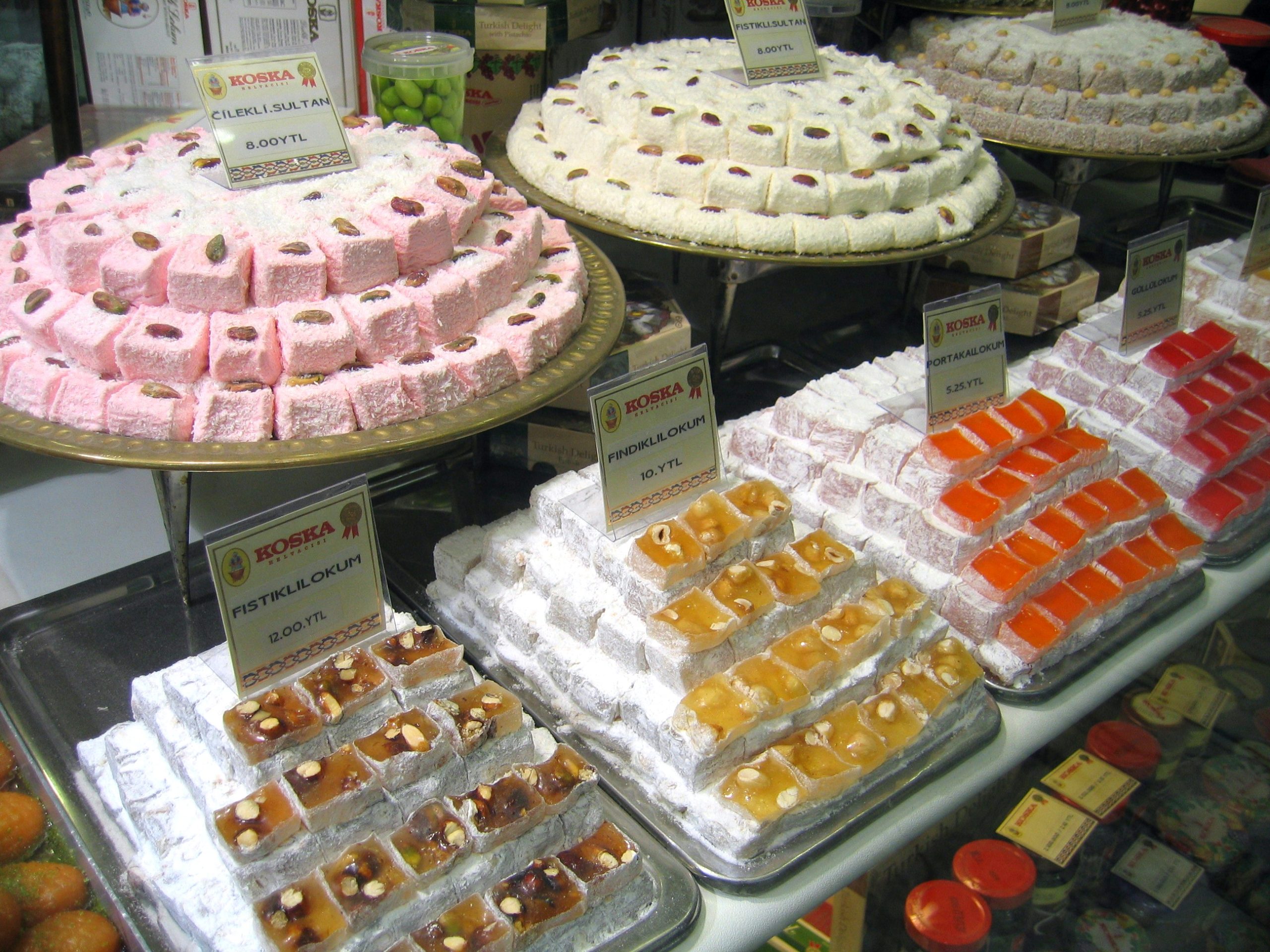
Lokum is sugar syrup and cornstarch cooked together for well over an hour until the cloudy paste turns translucent, thick, and golden, then perfumed with rose water, poured out to set overnight, and cut into soft cubes rolled in powdered sugar. Bite into a good one and it yields slowly rather than snapping. Making it at home is a genuine test of patience, since nothing about the process is fast, but the result tastes fresher and less cloying than most of what is sold in boxes.
Haci Bekir and the Sultan
Turkish delight is a jellied confection with origins in the late eighteenth century, and it became popular in Turkey around the turn of the nineteenth. The confectioner Haci Bekir Efendi, who came to Istanbul from Anatolia in the 1770s and opened a shop in the Bahcekapi district, is usually credited with its invention. Before refined sugar reached the region, the sweets made there had been sticky mixtures of honey or dried fruit and wheat flour, and the arrival of refined sugar and starch is what made the smooth modern texture possible. The English name dates from the 1830s, when a traveler carried samples home.
Sugar and Starch
There are only two structural ingredients. A sugar syrup is boiled to the soft-ball stage with a little lemon juice, which prevents the sugar from crystallizing later. Separately, cornstarch and cream of tartar are whisked into water and cooked into a thick, glue-like paste. The two are then combined, and the resulting mixture cooks down for a long time. A candy thermometer takes the guesswork out of the syrup stage, and the lemon juice is not optional, since without it the finished lokum turns grainy rather than smooth.
The Long Cook
Pour the hot syrup into the starch paste in a slow, steady stream while whisking hard, which is the step where lumps form if you rush. Then set the pan over very low heat and cook it for an hour or more, stirring every few minutes and scraping the bottom so nothing catches. Over that time the mixture darkens from opaque white to pale gold and becomes noticeably thick and translucent. There is no shortcut: cutting the time short leaves lokum that never sets and stays cloudy and starchy on the tongue. Watch for the moment it holds the trail of the spoon.
Flavor and Additions
Rose water is the classic flavoring and goes in at the end, off the heat, so its perfume survives; add it a little at a time and taste, since too much tips the sweet into soapy. Lemon, orange blossom, mastic, cinnamon, and pomegranate are all traditional alternatives, and food coloring gives the familiar pale pink or amber tints. Whole pistachios are the most common addition, with hazelnuts and walnuts also used. Stir the nuts in at the very end and pour quickly, since they sink toward the bottom while the mixture is still fluid.
Setting and Cutting
Pour the hot mixture into a pan lined with parchment and dusted with the powdered sugar and cornstarch blend, spread it level, and leave it uncovered at room temperature overnight, or for a full day if the kitchen is humid. Do not refrigerate it, which makes it weep and turn sticky. Once fully set and firm to the touch, turn it out, cut it into cubes with an oiled knife or kitchen scissors, and toss every side in the dusting mixture. That mix of powdered sugar and starch is what keeps the pieces separate; plain sugar alone dissolves into syrup within a day.
Serving Lokum
Lokum is served with Turkish coffee, the bitterness of the coffee balancing the sweetness of the cubes, and the pairing is close to inseparable in Turkey. It appears at bayram celebrations, is offered to guests as a matter of hospitality, and is given as a gift in decorated boxes. Store it in an airtight container at room temperature between layers of parchment dusted with the sugar mixture, where it keeps for weeks. Re-dust the pieces if they start to look damp after a few days.
Common Questions
Why did my lokum not set?
It was undercooked. The starch mixture needs well over an hour on low heat to thicken and turn translucent, and stopping early leaves it soft and cloudy. Cook until it visibly holds the trail of a spoon before pouring it out.
Why is it sticky the next day?
Either it was refrigerated or the dusting was powdered sugar alone. Set it uncovered at room temperature, and dust with a mix of powdered sugar and cornstarch, which absorbs moisture where plain sugar simply dissolves.
Can I use gelatin instead of starch?
Gelatin sets much faster but gives a bouncy, gummy texture rather than the soft yielding chew of real lokum. The cornstarch method is what defines the confection, and the long cook is the reason it tastes the way it does.
Turkish delight, known in Turkey as lokum, is a jellied confection with origins in the late 18th century; the confectioner Haci Bekir, who arrived in Istanbul from Anatolia in the 1770s, is often credited with its invention.