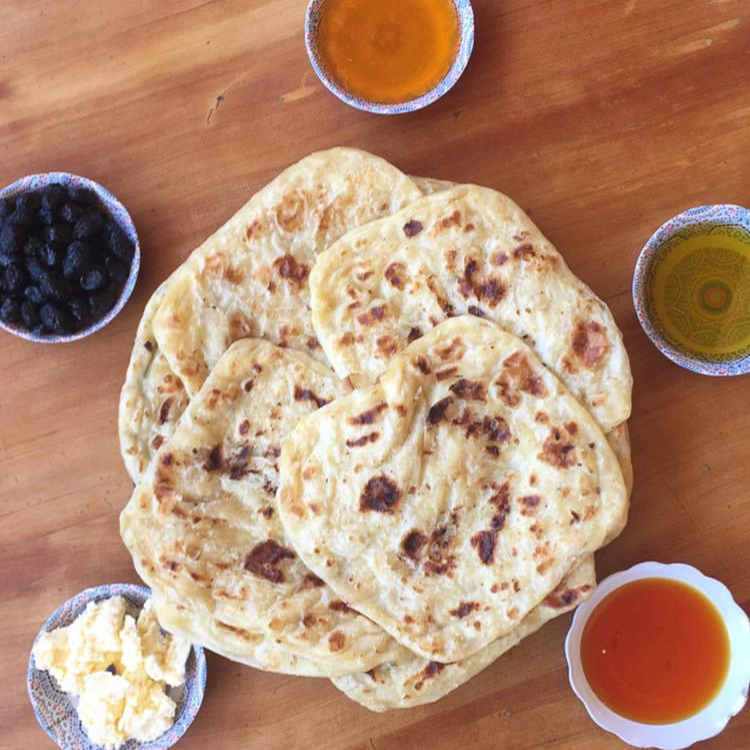
Msemen is Morocco’s flaky, square, pan-fried flatbread, made from dough that is stretched paper-thin, brushed with butter and oil, and folded into layers that separate into tender flakes as it cooks. Golden and crisp outside, soft and layered within, it is a breakfast and tea-time staple, served with honey drizzled over the top or stuffed with savory fillings. Making it takes some practice with the stretching and folding, but the technique is satisfying to learn, and warm msemen fresh off the griddle is worth the effort.
A Maghrebi Flatbread
Msemen is a traditional layered flatbread of the Maghreb, of Berber, or Amazigh, origin, common across Morocco and Algeria. It is folded into square pancakes with many thin internal layers and cooked on a griddle, most often eaten for breakfast or with afternoon mint tea. It goes by other names too, and a related version pulled into strands is called mlewi. It is a fixture of Moroccan home cooking and street food, sold plain to eat with honey or stuffed with onions, tomatoes, and spices. The layering technique is what sets it apart from a plain flatbread.
The Dough
Msemen dough is a soft, supple dough of flour and fine semolina, which gives the bread structure and a slight bite, mixed with water, salt, and a little sugar. Knead it well until it is smooth and elastic, since a well-developed dough stretches thin without tearing. Divide it into balls and coat them generously in oil, then let them rest. This oiling and resting is important: it relaxes the gluten and keeps the dough from drying out, so it can be stretched extremely thin later. A soft, well-rested, oiled dough is the starting point for good msemen.
Stretching Thin
The heart of msemen is stretching the dough paper-thin. On an oiled surface, flatten and stretch each rested ball outward with your hands into a large, very thin sheet, almost translucent. The thinner you can stretch it without tearing, the more delicate and flaky the layers will be. The generous oil on the dough and surface is what lets it stretch so far. This takes practice; the first few will tear, and that is fine. Work gently from the center outward, easing the dough thinner and thinner. This thin sheet is what gets folded into the many layers.
Folding the Layers
Once the dough is stretched thin, brush it with melted butter and oil and sprinkle it with a little fine semolina. Then fold it into a square: fold the sides in over the center and the top and bottom in, so you end up with a folded packet of many thin layers with fat and semolina between them. This fat and grit between the layers is exactly what makes msemen flaky, keeping the layers separate as they cook so they puff and flake apart. Flatten the folded square gently to spread it back out a little without pressing the layers together. Now it is ready to cook.
Cooking
Cook msemen on a hot griddle or heavy pan, with a little butter or oil. Lay the folded square down and cook it until the bottom is golden, then flip, pressing gently with a spatula to help it cook through and crisp, and cook the other side. It should turn golden brown and crisp on the outside while staying soft and layered inside. As it cooks, the layers separate into flakes. Cook it through so the interior is not doughy. Msemen cooks fairly quickly on good heat, so watch it and flip as each side browns.
Serving Msemen
Serve msemen warm, fresh off the griddle, when it is at its flakiest. The classic way is drizzled with honey and melted butter for breakfast or with mint tea, though it is also lovely with cheese or jam. For a savory version, tomatoes, onions, and spices are folded inside before cooking, making a stuffed msemen that is a meal in itself. It is best warm, since it firms up as it cools; a quick reheat on the griddle brings it back. Make a stack and serve them as they come off the heat, with honey and tea alongside.
Common Questions
Why does my msemen not have layers?
The dough was not stretched thin enough, or not enough butter and oil went between the folds. Stretch it almost translucent, brush generously with fat and semolina, then fold. The thin sheet plus the fat between layers is what creates the flakes.
Can I make them savory?
Yes. Fold a filling of cooked onions, tomatoes, and spices into the dough square before cooking to make stuffed msemen, a popular savory version that is a meal on its own. The folding technique is the same; you just add the filling.
What flour should I use?
A mix of regular flour and fine semolina is traditional. The semolina gives structure and a slight bite, while the flour keeps the dough supple. Use fine semolina, not coarse. A little extra fine semolina is also sprinkled between the layers when folding.
Msemen is a traditional layered flatbread of the Maghreb, of Berber origin, folded into square pancakes with many thin internal layers and cooked on a griddle, served for breakfast or tea.