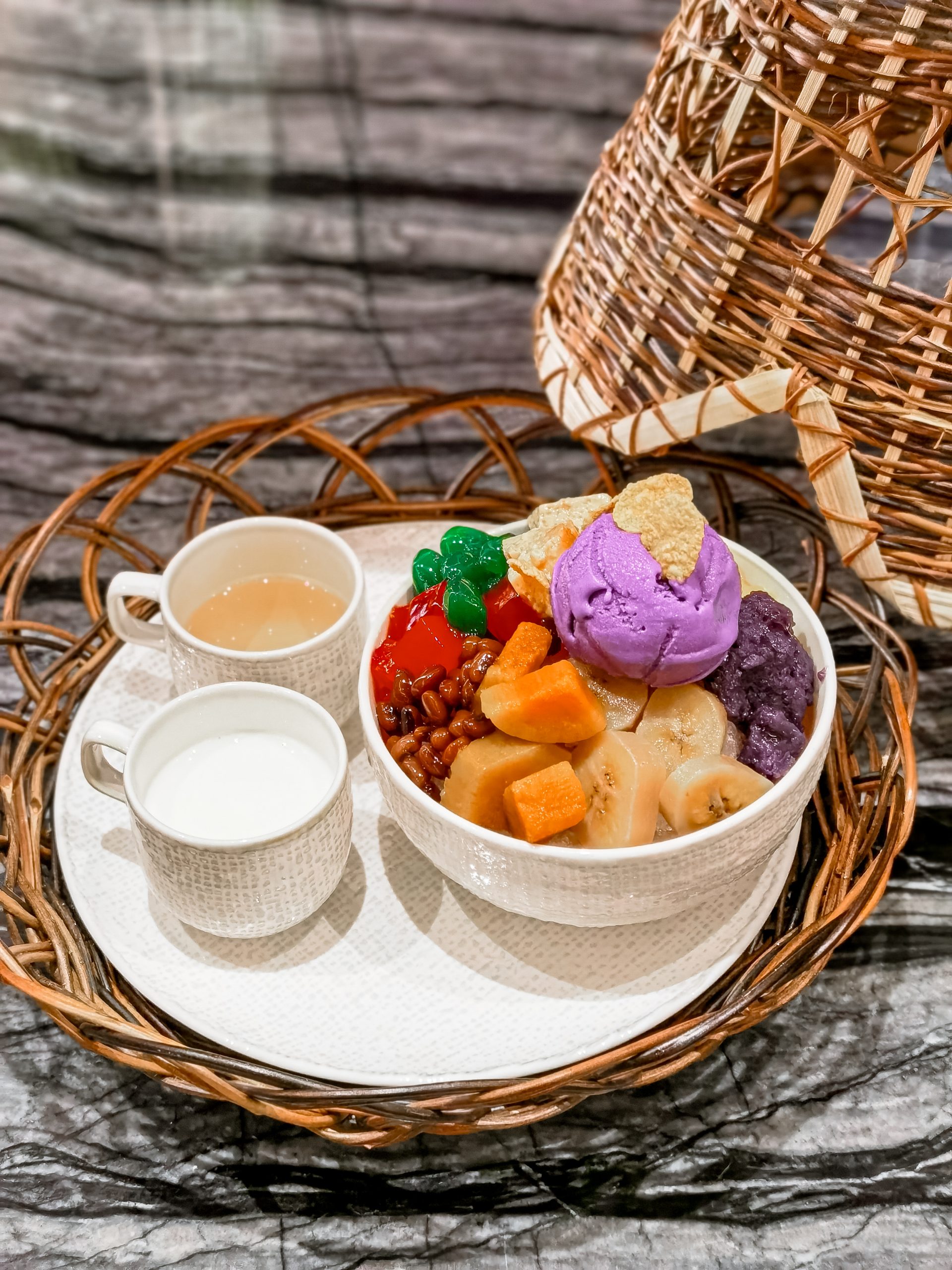
Halo-halo is the Philippines’ great summer dessert, a tall glass layered with sweet beans, chewy jellies, candied fruit, shaved ice, and evaporated milk, crowned with a slice of leche flan and a scoop of purple ube ice cream. The name means mix-mix, and that is the instruction: you stir the whole colorful tower into a cool, creamy, textured slurry and eat it with a long spoon. No two versions are identical, and half the fun is the jumble of things you meet in each bite.
Mix-Mix by Name and Nature
Halo-halo is defined by variety rather than a fixed recipe. The word describes the action of mixing, and the dessert is essentially a framework: shaved ice and milk over an assortment of sweet toppings, finished with something rich on top. Its roots are often traced to the Japanese kakigori shaved-ice tradition brought to the Philippines in the early twentieth century, which Filipinos expanded into the loaded, layered dessert known today. It is street food, restaurant dessert, and home treat all at once, sold everywhere the moment the weather turns hot.
The Sweet Base Layers
The bottom of the glass holds the sweet, chewy, and fruity components, and this is where halo-halo shows its range. Common additions include sweetened red and white beans, garbanzos, nata de coco (chewy coconut jelly), kaong (sugar palm fruit), sweetened jackfruit, candied saba plantain, macapuno coconut strings, and colored gulaman jelly. Most come in jars at Filipino groceries, sold specifically for this dessert, so assembling halo-halo is more about shopping than cooking. Use a spoonful of several rather than a lot of any one; the variety is the point.
Ice and Milk
Over the sweet base goes a mound of ice, and its texture matters. Finely shaved or well-crushed ice melts smoothly into the milk and blends into the creamy slush halo-halo becomes; coarse cubes stay hard and clunky and refuse to mix. A shaved-ice machine gives the best result, but a blender pulsed with ice, or ice crushed in a sturdy bag, gets close. Evaporated milk is the traditional pour, richer than fresh milk, and it soaks down through the ice to bind the whole glass. Some cooks add a little condensed milk for extra sweetness.
The Crowning Toppings
What turns a glass of iced beans into halo-halo is the top. A slice of leche flan, the Filipino caramel custard, and a scoop of ube ice cream, made from purple yam, are the classic crowns, and the ube gives the dessert its signature violet color and gentle earthy sweetness. Toasted pinipig, flattened young rice, adds a crunchy, nutty scatter. Some versions add a scoop of plain ice cream, a spoon of sweet purple yam jam, or a sprinkle of cornflakes. These finishing layers are the difference between a decent halo-halo and a memorable one.
How to Eat It
Serve halo-halo the instant it is built, because the ice waits for no one. Hand each person a long spoon and tell them to mix, really mix, mashing the flan and ice cream down through the ice and beans until the whole glass turns into a pale purple, creamy, many-textured slush. That blended spoonful, cold and sweet with soft beans, chewy jelly, and crunchy rice all at once, is the entire experience. Eating the layers separately misses the point; halo-halo only becomes itself once it is stirred into chaos.
Building It Your Way
There is no wrong halo-halo, only your halo-halo. Filipino families keep favorite combinations, and shops advertise special versions loaded with extra ingredients. Start with whatever the jars at your Filipino grocery offer, use a few beans, a couple of jellies, some fruit, ice, milk, and at least one rich topping, and adjust next time. It is a build-your-own dessert by design, forgiving of substitutions and impossible to truly ruin as long as the ice is fine and the milk is generous. On a hot afternoon, few things are more satisfying.
Common Questions
Where do I buy the toppings?
Filipino groceries sell jarred beans, nata de coco, kaong, sweetened jackfruit, and more, often on one shelf labeled for halo-halo. Many Asian supermarkets stock them too. Ube ice cream and leche flan are sold there as well, or you can make the flan yourself.
What is ube?
Ube is purple yam, a naturally violet tuber with a mild, sweet, faintly nutty flavor, popular across Filipino desserts. It gives halo-halo its color when used as ice cream or jam. It is different from purple sweet potato, though the two look similar.
Can I make it without a shaved-ice machine?
Yes. Crush ice in a blender in short pulses, or seal cubes in a sturdy bag and crush them by hand, aiming for a fine, snow-like texture. Finer ice blends into the milk far better than coarse chunks.
Halo-halo means mix-mix, and this layered shaved-ice dessert is the Philippines' answer to summer heat, its many components stirred together into one cool, sweet, colorful bowl.