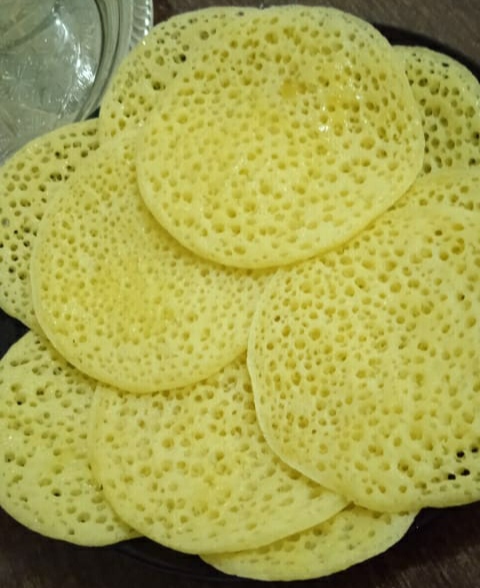
Baghrir are the pancakes with a thousand holes: a thin semolina batter poured into a dry pan, where the surface erupts into hundreds of tiny craters as it cooks, leaving a spongy honeycomb that soaks up melted butter and honey like nothing else. They are cooked on one side only, never flipped, and they are soft, slightly tangy, and impossible to eat neatly. Making them is a small piece of kitchen theater, and once the batter is right they come out perfectly every time.
Pancakes of the Maghreb
Baghrir, also spelled beghrir and known in places as ghrayef or mchahda, is eaten across Morocco, Algeria, and Tunisia. In Morocco it belongs to the breakfast table and to the afternoon tea spread, and it appears reliably during Ramadan as part of the iftar, where its soft sweetness balances a bowl of harira. The nickname, thousand-hole pancake, describes exactly what makes it worth the trouble: that porous surface holds far more of the honey and butter poured over it than any flat pancake could. It sits alongside msemen and harcha in the Moroccan bread repertoire, each with a completely different texture.
Semolina and Yeast
The batter is built on fine semolina with a smaller proportion of plain flour, plus yeast, baking powder, sugar, salt, and a generous amount of warm water. Fine semolina is what matters; coarse semolina leaves the pancakes gritty and interferes with the holes. Both leaveners are doing work: the yeast ferments and gives the batter its faint tang and its gas, while the baking powder adds a quick burst of lift in the pan. Warm water, not hot, wakes the yeast without killing it. The proportions favor liquid heavily, which surprises people used to thick pancake batter.
Blending and Resting
Use a blender if you have one, which is the reliable route to the smooth, thin, entirely lump-free batter this recipe depends on. Blend for a full minute so the semolina hydrates and breaks down; a whisked batter with any grit or lumps produces flat, hole-free pancakes. The consistency lands closer to thin cream than to batter, running freely off a spoon. Then let it rest somewhere warm until the surface is covered in bubbles, which takes roughly twenty to thirty minutes depending on the room. Do not stir it after resting, since stirring knocks out the gas that makes the holes.
The Dry Pan
Heat a nonstick pan or a well-seasoned griddle over medium heat and put absolutely no oil or butter in it. This is the rule people break most often, and greasing the pan prevents the bubbles from rising and setting, leaving a smooth, closed surface. Pour a ladle of batter into the center and let it spread outward by itself rather than tilting the pan. Within seconds, holes begin appearing across the surface and spreading toward the edge. Get the heat right: too low and the holes form slowly and close again, too high and the base scorches before the top sets.
One Side Only
Baghrir are never turned. Cook each one until the entire surface is covered in open holes and the top has gone from wet and glossy to dry and matte, then lift it straight out of the pan. Flipping it seals the holes and produces an ordinary pancake, losing everything that makes baghrir distinctive. Lay the finished pancakes flat on a cloth in a single layer to cool rather than stacking them immediately, since stacking hot ones makes them stick together. Once cool they can be stacked freely and stored, and they reheat gently in a warm pan.
Serving Baghrir
The standard topping is honey whisked into melted butter and poured warm over the pancakes so it runs into every hole. Amlou, the Moroccan spread of toasted almonds, honey, and argan oil, is the other classic, richer and nuttier. Serve them with mint tea for breakfast or in the afternoon, and expect people to eat several. They keep well for a day or two wrapped at room temperature, and they freeze successfully with parchment between the layers, which makes a large batch worth the twenty minutes of pouring.
Common Questions
Why did my baghrir not form holes?
The batter was too thick, not blended smooth, under-rested, or the pan was greased. Blend until completely smooth and thin, let the batter bubble in a warm place, and cook in a completely dry pan over medium heat.
Can I use regular flour instead of semolina?
Fine semolina is what gives baghrir its texture and its structure, so an all-flour version behaves differently and comes out closer to a crumpet. Keep semolina as the main ingredient with a smaller amount of plain flour alongside it.
How do I store them?
Cool them flat in a single layer first so they do not stick, then stack and wrap them. They keep a couple of days at room temperature and freeze well with parchment between each one. Reheat briefly in a dry warm pan.
Baghrir, also called beghrir, ghrayef, or mchahda, is a spongy semolina pancake eaten across Morocco, Algeria, and Tunisia, riddled with tiny holes that soak up whatever it is served with.