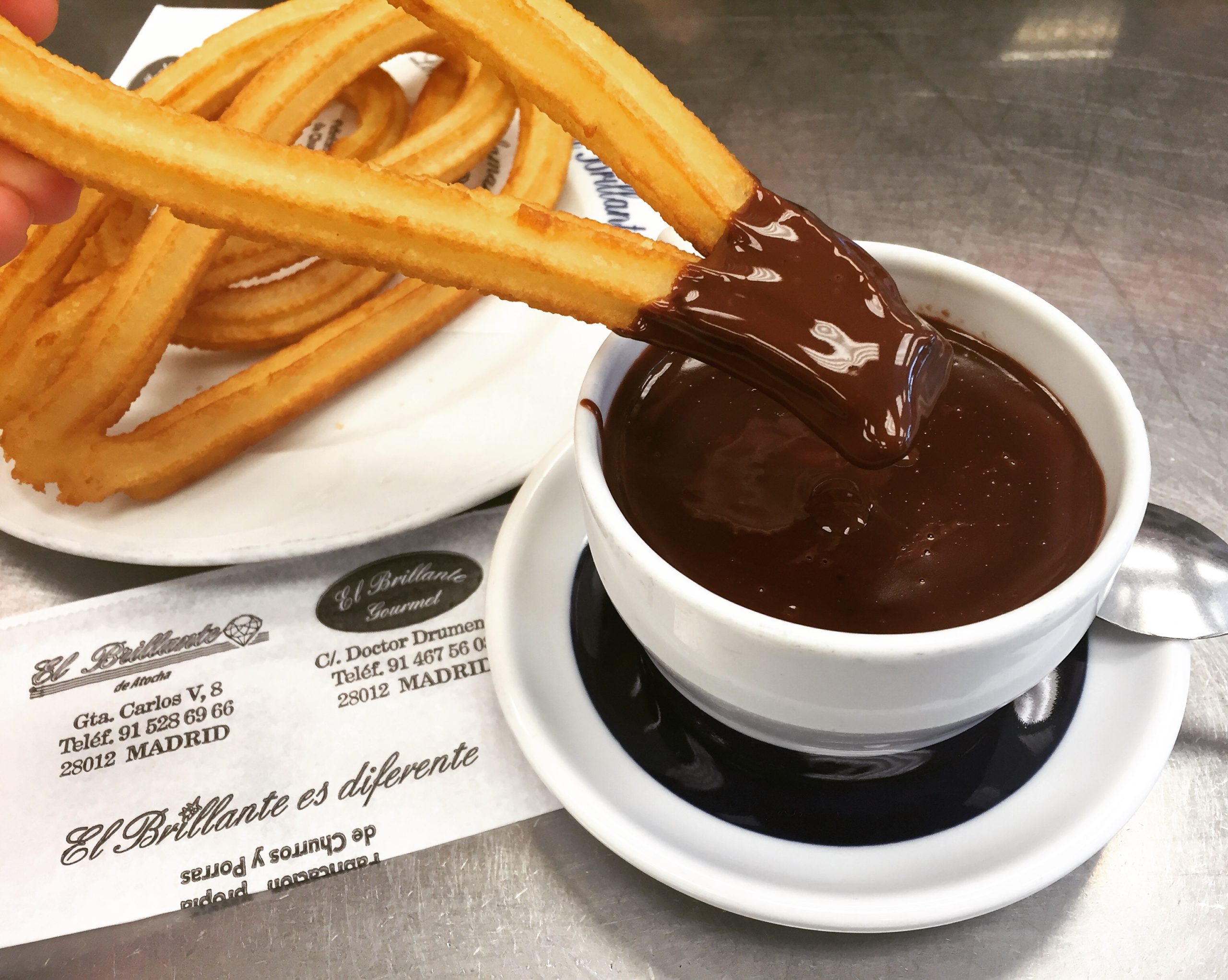
Churros con chocolate is one of Spain’s happiest rituals: ridged ropes of fried dough, shatteringly crisp outside and tender within, dusted with sugar and dunked into a cup of hot chocolate so thick it coats the churro like a sauce. Spaniards eat them for breakfast, at the afternoon merienda, and famously at dawn after a long night out. The dough is a five-minute affair of flour and boiling water; the craft is in the star tip, the oil temperature, and a chocolate that respects the tradition of thickness.
A Spanish Institution
The churro is woven into Spanish daily life through the churreria, the shop or stall that fries them fresh in looping coils, and the chocolateria, where cups of thick drinking chocolate wait for dunking; Madrid’s famous chocolaterias, open into the small hours, have made churros the traditional end of a night out as much as the start of a morning. How churros began is genuinely murky, with competing legends, including one crediting shepherds who fried simple dough over fires, and no settled answer, so the origin stories are best enjoyed as stories. What is certain is where the churro reigns: across Spain, and far beyond it through Latin America, each place with its own variations.
A Simple Scalded Dough
Classic Spanish churro dough is austere: water, flour, salt, and a little fat and sugar, with no egg in the traditional version. Bring the water to a boil with the butter or oil, salt, and sugar, pull it off the heat, and stir in the flour all at once until it gathers into a smooth, thick, glossy paste. The boiling water scalds the flour, which is what lets the dough pipe cleanly and fry with a crisp shell and a tender, slightly chewy heart. Let it cool for a few minutes so it firms and stops steaming, and it is ready for the bag.
The Star Tip Matters
Churros are piped, traditionally from a churrera and at home from a sturdy piping bag, and the star-shaped tip is functional, not decorative. The ridges increase the surface that crisps and let the interior cook through evenly; dough piped through a smooth round opening fries into a pale, doughy rope whose sealed surface can trap steam and burst in the oil. Use a large star tip and a strong bag, since the dough is stiff. Pipe lengths directly over the hot oil and snip them free with scissors, straight rods or the classic loops, whichever your wrist prefers.
Frying to Deep Gold
Heat the oil to 350 F and keep it there, frying a few churros at a time so the temperature holds. They need a few minutes, turned once, until they reach a deep, even gold; pale churros are raw at the center, and oil that is too cool makes them heavy and greasy while oil too hot burns the ridges before the middle sets. Drain them on a rack, and while they are still warm, roll or dust them with sugar, plain in the strict Spanish style, or with a pinch of cinnamon in the style loved across Latin America and beyond. Eat them fresh; churros wait for no one.
Chocolate Like Velvet
Spanish dipping chocolate is a category of its own: thick, glossy, and barely pourable, closer to warm pudding than to cocoa. Melt dark chocolate into milk with a little sugar, then whisk in a slurry of cornstarch and cold milk and cook, whisking, until the chocolate visibly thickens and coats a spoon in a heavy layer. It is served in small cups, half drink and half sauce, and the churro is its spoon. If the chocolate runs off the churro like drinking cocoa, it wants another minute on the heat; when in doubt, thicker is more Spanish.
Serving Churros
Serve churros hot from the fryer, stacked on a plate with the cups of thick chocolate alongside, and let everyone dunk. In Spain they are a breakfast, a merienda with coffee, and the classic dawn finish to a night out; at home they make a spectacular weekend breakfast or a dessert that draws a crowd to the kitchen. They are best within the hour and do not keep, though the dough can rest while you fry in waves. Leftover dipping chocolate, should such a thing exist, reheats gently into tomorrow’s excuse to fry again.
Common Questions
Why did my churros burst in the oil?
Almost always the tip: smooth, thick ropes trap steam. Pipe through a star tip so the ridged surface vents and crisps, keep the ropes modest in thickness, and hold the oil at 350 F. Burst churros are a tip problem, not a dough problem.
Is there egg in churro dough?
Not in the traditional Spanish version, which is water, flour, salt, and a little fat and sugar. Some recipes abroad add egg for a softer, choux-like churro. Both fry well; the eggless dough is the classic and the simplest.
Can I make the dough ahead?
The dough is best used within a few hours, kept covered at room temperature, since it stiffens and dries as it sits. Fried churros do not store. The chocolate, happily, makes ahead and reheats gently with a whisk.
Churros are ropes of fried dough piped through a star tip, a Spanish breakfast and late-night classic served with thick hot chocolate for dipping; their deeper origins are the subject of competing legends.