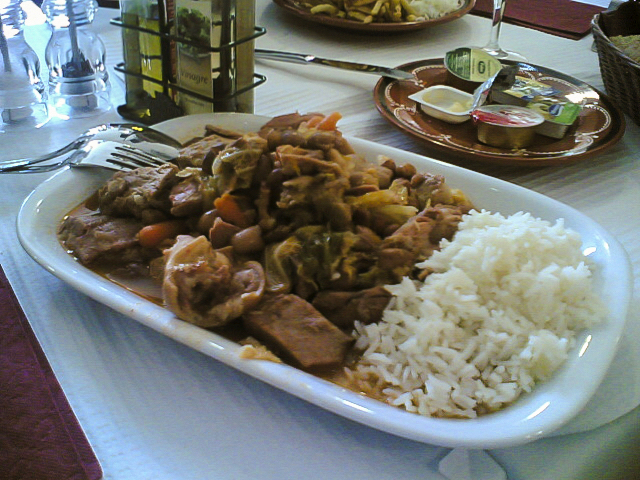
Feijoada is Brazil’s most celebrated dish and its most social one: a deep, glossy stew of black beans simmered for hours with a parade of pork and beef cuts, smoked, salted, and fresh, until the beans turn creamy and the broth nearly black. It never arrives alone. White rice, farofa, garlicky collard greens, and orange slices surround it by law of custom, and in Brazil the whole production traditionally lands on the table at Wednesday and Saturday lunch, followed by an afternoon of doing very little. Feeding eight from one pot, feijoada is less a recipe than an event.
A National Dish With Layers of History
Bean-and-meat stews came to Brazil with Portuguese colonizers, whose own cozidos follow the same logic, and the dish evolved over centuries with African and indigenous influences into something distinctly Brazilian. A popular legend claims feijoada was born in slave quarters from discarded cuts; food historians have pushed back on that story, noting the dish’s ties to Portuguese stew traditions and its early appearances in urban restaurants. What is beyond argument is its status today: feijoada completa is the national dish, served across every region and social class, and restaurants in Rio de Janeiro build their entire week around feijoada days.
The Meats, and Why There Are So Many
Feijoada gets its depth from variety. Carne seca, Brazilian salt-cured dried beef, brings concentrated beefy intensity; salted pork ribs add body and richness; linguica or another smoked sausage layers in garlic and smoke; bacon rounds out the fat. Traditional pots in Brazil also welcome pig’s feet, ears, and tail, which contribute collagen and are considered marks of a serious feijoada. The salted meats demand advance work: soak them in cold water for 24 hours, changing the water three or four times, to pull the salt down to edible levels. Skip the soak and no amount of cooking rescues the pot.
Black Beans, Low Heat, Long Time
Brazilian black beans, soaked overnight, simmer with bay leaves while the meats join in stages according to their toughness: desalted carne seca and ribs early, sausage and bacon later, so everything finishes tender at once. The pot barely bubbles for close to three hours. Toward the end comes a technique worth stealing for every bean dish you make: mash a ladleful of beans against the pot wall, or blend a cupful and stir it back, thickening the broth to its signature velvety weight. Onion and garlic, fried in olive oil until golden and folded in during the final stretch, wake the whole pot up. Salt only at the end, after tasting, because the meats season the beans continuously.
The Accompaniments Are Not Optional
Feijoada completa means the complete spread, and each element has a job. Plain white rice provides the neutral base. Farofa, toasted cassava flour usually fried in butter with onion or bacon, adds a sandy crunch that Brazilians spoon directly over the beans. Couve, collard greens sliced into fine ribbons and flash-fried with garlic, cuts the richness with a bitter green edge. And the orange slices, eaten between bites, refresh the palate and are as mandatory as the beans themselves. A bottle of hot sauce and, for the adults, a caipirinha or a small glass of cachaça complete the table in the classic Rio manner.
Feeding a Crowd, Feeding the Freezer
This recipe serves eight, and feijoada punishes attempts to halve it; the variety of meats is the dish. Cook the full pot and let leftovers become the reward. Like every long-simmered bean stew, it improves markedly overnight and keeps four days refrigerated. It freezes beautifully for three months in portioned containers, and a frozen block of feijoada, reheated gently with fresh rice and a quickly fried batch of collards, ranks among the best fast dinners a freezer can hold.
Common Questions
What is the traditional day to serve it?
Wednesday and Saturday are feijoada days in Brazilian restaurant culture, especially in Rio, where the Saturday feijoada stretches into a long afternoon with music and cold drinks. At home it is a weekend lunch by nature, since nobody schedules anything ambitious after a full plate of it.
Where do I find carne seca and linguica?
Brazilian and Portuguese groceries carry both, and Latin markets often stock close relatives; Mexican cecina or additional salted beef substitutes for carne seca, and Spanish chorizo or Polish kielbasa stands in for linguica. The stew forgives substitutions as long as something smoked and something salt-cured make it into the pot.
Can I use canned black beans?
For true feijoada, no; the beans need hours alongside the meats to trade flavor. For a weeknight approximation, simmer canned beans with browned sausage and bacon for forty minutes and call it feijão gostoso, tasty beans, which Brazilians make constantly.
Why oranges?
Tradition holds that the acidity aids digestion of the rich stew, and the palate agrees: a segment of cold orange between spoonfuls resets your taste and makes the next bite land as strongly as the first.
Feijoada is Brazil\'s national dish, a rich and flavorful black bean stew that tells the story of the country\'s history. Originating from the kitchens of enslaved Africans, who would cook the leftover cuts of pork and beans, it evolved into a celebratory meal enjoyed across all social classes. The preparation is a multi-day affair, involving soaking and desalting various salted meats, slow-cooking the beans, and then combining everything into a deeply satisfying stew. It\'s a dish meant to be shared, often served on Saturdays with a spread of rice, farofa (toasted cassava flour), collard greens, and orange slices.