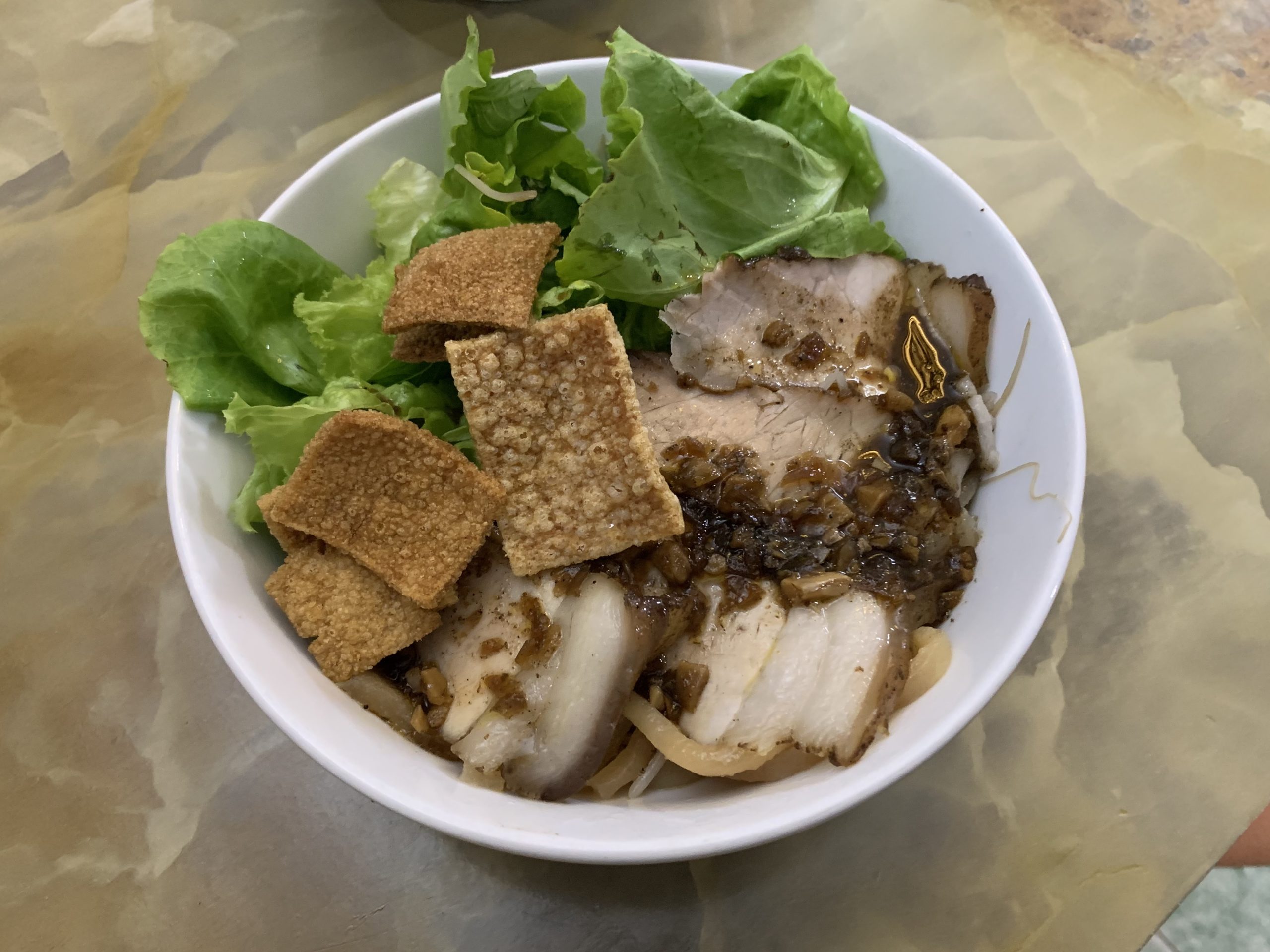
Cao lau is a bowl of thick, chewy, brownish noodles topped with slices of five-spice braised pork, a handful of crisp fried squares, a mound of fresh herbs and bean sprouts, and only a few spoonfuls of intensely concentrated braising liquid pooled at the bottom. It is not a soup. Everything gets tossed together before eating, and the pleasure lies in the collision of textures: dense noodles, tender pork, shattering crisp bits, and cool raw greens.
A Dish From One Town
Cao lau belongs to Hoi An, the old trading port on the central Vietnamese coast, and it is unusual in being tied so tightly to a single city. Hoi An spent centuries as an international port where Japanese, Chinese, and later European traders settled, and the dish carries traces of that history: the thick noodles invite comparison with Japanese udon, while the five-spice pork and crisp garnishes point toward Chinese cooking. Even within central Vietnam it stands apart from its neighbors, including mi Quang from the same region, which uses turmeric-tinted noodles and a different broth entirely.
The Noodles
The noodles are what make cao lau impossible to reproduce exactly outside Hoi An. They are made from rice soaked in lye water, which gives them their characteristic dense chew and their faintly grey-brown color, quite unlike the white translucent noodles used elsewhere in Vietnam. Local tradition holds that the water must come from a particular ancient well in the town and the ash from trees on the nearby Cham Islands. Away from Hoi An, thick udon or the packaged noodles sold as cao lau at Vietnamese markets are the practical substitutes, and both give a reasonable approximation of the texture.
The Pork
Pork shoulder is marinated in five spice, soy sauce, fish sauce, garlic, shallot, and sugar, then seared and braised slowly until tender enough to slice thinly without falling apart. The five spice is the dominant flavor and goes on generously, since it has to carry through the whole bowl. Rub it into every surface of the meat and let the marinade work for several hours if the schedule allows, because a lightly seasoned pork leaves the finished bowl tasting flat against the dense noodles. Braise it in a small amount of liquid rather than covering it, because the liquid reduces into the concentrated sauce that dresses the noodles later. Let the meat rest before slicing so it holds together, and cut it across the grain into thin pieces.
The Crisp Squares
Scattered over every bowl are small squares of fried dough that shatter when bitten. In Hoi An these are made from the same cao lau noodle dough, cut into squares and deep-fried until golden and puffed. At home, wonton wrappers or rice paper cut into pieces and fried give the same effect in a fraction of the time. They are not a garnish to be picked off: their crunch against the dense chew of the noodles is one of the defining contrasts of the dish, and a bowl without them feels incomplete.
Assembly
Build each bowl in order. A bed of raw bean sprouts and torn lettuce goes in first, then the warmed noodles on top, then slices of pork arranged over them. Spoon over just a few tablespoons of the reduced braising liquid, enough to season everything without turning it into soup, and finish with the crisp squares and a generous handful of Vietnamese mint, perilla, and other herbs. Lime wedges and sliced chili go on the side. The eater tosses it all together before starting, which is how the dish is meant to be approached.
Serving Cao Lau
Serve it warm rather than hot, since the raw greens and the small quantity of liquid mean it was never intended to arrive steaming. In Hoi An it is sold from small shops and market stalls, often alongside a plate of extra herbs for topping up. Eat it with chopsticks and a spoon for the sauce at the bottom. Everything can be prepared in advance, with the pork braised and the squares fried ahead, leaving only assembly at the last minute, which makes it easier to serve than the long ingredient list suggests.
Common Questions
What noodles should I use?
Packaged cao lau noodles from a Vietnamese market are the closest option. Thick udon is the widely available substitute and gives a similar dense chew. Regular flat rice noodles are too soft and change the dish considerably.
Is cao lau a soup?
No. Only a few spoonfuls of concentrated braising liquid go into each bowl, enough to coat the noodles when everything is tossed together. Adding broth turns it into a different dish entirely and washes out the flavors.
How is it different from mi Quang?
Both come from central Vietnam and both use small amounts of liquid, but mi Quang has yellow turmeric-tinted noodles and a shrimp or chicken broth, while cao lau uses dense lye-treated noodles with five-spice pork. They are neighbors, not variations.
Cao lau is a regional noodle dish from the city of Hoi An in central Vietnam, built on thick rice noodles whose distinctive texture and color come from soaking the rice in lye water.