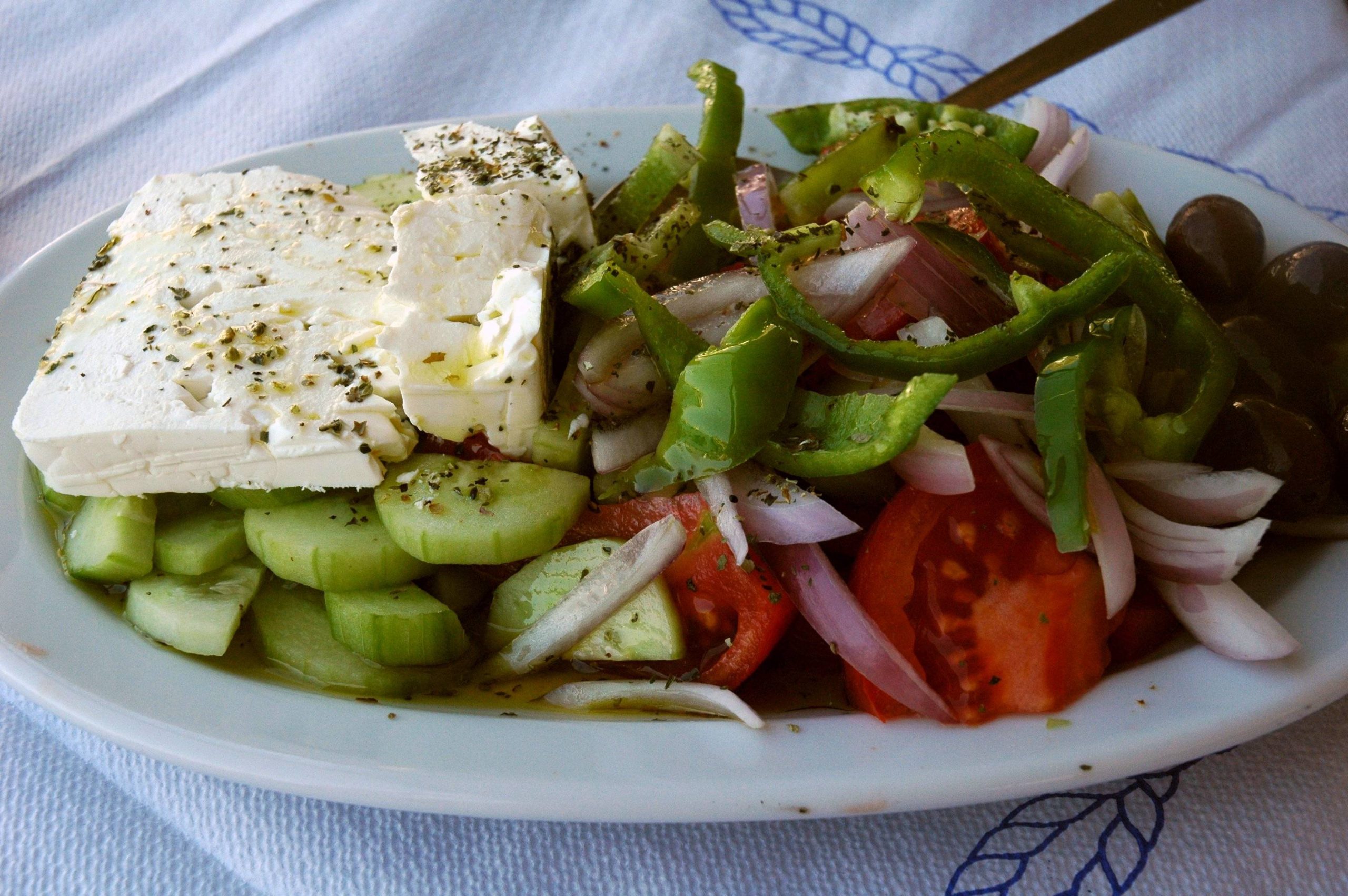
A real Greek salad has no lettuce. It is a plate of ripe summer vegetables, tomatoes, cucumber, onion, and peppers, tossed with olives, topped with a slab of feta, and dressed with nothing more than good olive oil and dried oregano. In Greece it is called horiatiki, village salad, and it is exactly as simple as it sounds. That simplicity is also its demand: with almost nothing cooked and nothing to hide behind, the salad is only as good as the produce and the olive oil that go into it.
The Village Salad
Horiatiki means from the village, and the dish is peasant food in the best sense: whatever fresh vegetables the garden held, dressed with the household olive oil and a little cheese. The lettuce-free, feta-topped version is the standard across Greece, served at every taverna alongside grilled meats and fish. The plate is meant to be shared, set in the middle of the table for everyone to reach into. What it is not is a bowl of greens with a few toppings, which is the common misunderstanding abroad. It is a salad of vegetables, olives, and cheese.
Produce Is Everything
Because so little is done to the ingredients, their quality is the whole dish. Use the ripest tomatoes you can find, ideally in-season summer ones bursting with flavor, since pale winter tomatoes make a sad, watery salad. Firm cucumber, sharp red onion, and crisp green pepper round out the vegetables. This is a summer dish by nature, and it rewards a trip to a good market. If your tomatoes are not excellent, the salad will not be either, and no amount of dressing fixes flavorless produce.
Feta on Top
The feta is not crumbled through the salad in the traditional version; it is laid on top as a single thick slab, dusted with oregano and drizzled with oil. As you eat, it softens in the oil and you break off pieces with each bite. Use real Greek feta made from sheep’s milk, or sheep and goat, for the proper tangy, creamy character; the firmer cow’s-milk imitations are a poor substitute. The block sitting on top is part of how the salad looks and how it eats, so resist the urge to stir it in.
The Dressing
There is no elaborate dressing. Good extra virgin olive oil, in a generous amount, is the base, poured over the vegetables and the feta. Dried oregano, rubbed between the fingers to release its aroma, is the essential herb. Salt seasons the vegetables and draws out the tomato juices, which mingle with the oil into a light dressing at the bottom of the plate that begs to be soaked up with bread. Some cooks add a splash of red wine vinegar; many use none, letting the tomato acidity and oil do the work. Keep it minimal.
Serving It
Greek salad is served at room temperature, not chilled, so the tomatoes taste of something and the oil stays loose. Dress it just before serving so the vegetables stay crisp and do not weep. Bread on the table is close to mandatory, for mopping up the pool of oil and tomato juice that collects, which many consider the best part. It sits alongside grilled souvlaki, fish, or any Greek meal, and it doubles as a light meal on its own with good bread and a glass of wine. Do not refrigerate leftovers long; it is a fresh dish.
What Not to Add
Part of making a good Greek salad is restraint. No lettuce, as covered. No heavy vinaigrette, no croutons, no crumbled feta stirred through, no dried herbs beyond oregano. These additions turn it into a generic mixed salad and lose what makes horiatiki itself. The Greek approach trusts a few excellent ingredients to carry the plate, and adding more only muddies it. Keep it to ripe vegetables, olives, a slab of feta, olive oil, oregano, and salt, and the salad tastes exactly as it should.
The Bread at the Bottom
Ask a Greek what the best part of a horiatiki is and many will point to the bottom of the plate. As the salad sits, the salted tomatoes release their juices, which mingle with the olive oil and the brine from the feta and olives into a light, savory dressing that pools underneath. Tearing off a piece of bread and dragging it through that pool, papara as it is sometimes called, is a small ritual at the Greek table. It is the reason bread belongs beside the salad, and the reason you should not drain that liquid away. Make the salad, let it sit a few minutes, and save the last of it for the bread.
Common Questions
Does a real Greek salad have lettuce?
No. The traditional horiatiki has no lettuce. It is a salad of tomatoes, cucumber, onion, peppers, olives, and feta. The lettuce version is a foreign adaptation, not the Greek original.
Should I crumble the feta?
Traditionally no. Lay it on top as a slab, sprinkled with oregano and oil. It softens as you eat and you break off pieces. Crumbling it through is a common variation, but the slab on top is the classic presentation.
Do I need vinegar?
It is optional. Many Greek cooks use only olive oil, letting the ripe tomatoes provide the acidity. A small splash of red wine vinegar is a common addition. Use it or skip it to taste.
The Greek salad, known in Greece as horiatiki or village salad, is a simple plate of raw summer vegetables, olives, and feta dressed with olive oil, with no lettuce in the traditional version.