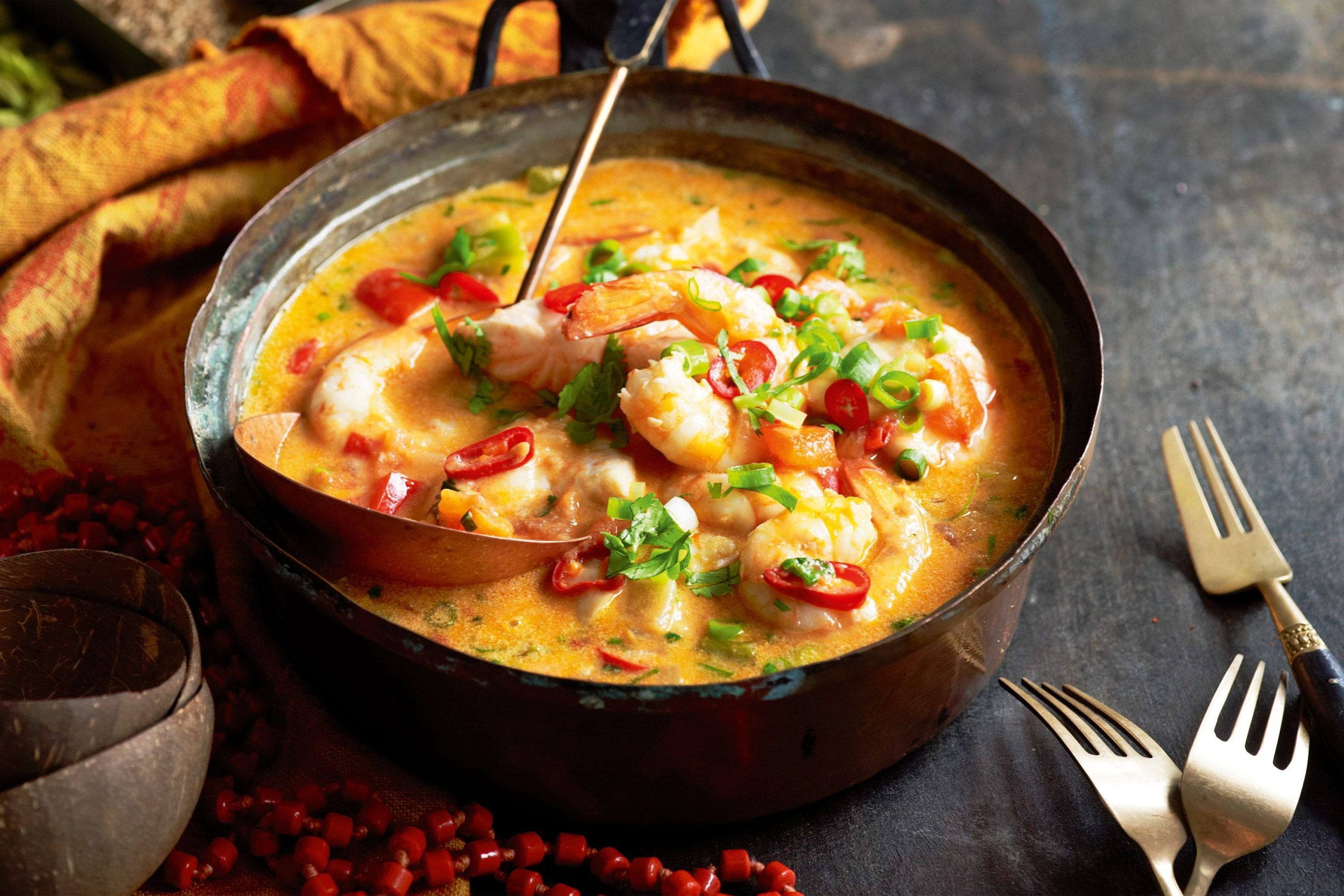
Moqueca is Brazil’s great fish stew: chunks of firm white fish poached in a fragrant broth of coconut milk, tomatoes, peppers, and red palm oil, finished with lime and a shower of cilantro. It is bright orange, aromatic, and built in layers rather than stirred, so the fish stays in whole pieces. Spooned over white rice, it turns a pound and a half of fish into a meal for four, and it comes together in under an hour.
Two Coasts, Two Versions
There are two main moquecas, and Brazilians hold strong opinions about both. Moqueca baiana, from Bahia in the northeast, uses coconut milk and dende, the red palm oil brought across the Atlantic through the region’s African heritage. Moqueca capixaba, from Espirito Santo, skips both and leans on annatto for color and a lighter broth. This recipe follows the Bahian style, the richer and more widely known of the two. Both are cooked slowly and served from the pot they were made in.
Dende, the Ingredient That Defines It
Dende, red palm oil, is what gives Bahian moqueca its deep orange color and its particular earthy flavor. Nothing copies it exactly. A small amount of annatto oil supplies color and a hint of earthiness if dende is out of reach, but the dish tastes different without the real thing. Latin and African groceries carry dende in bottles. Use it in moderation, since its flavor is assertive and a little goes a long way.
Choosing the Fish
Firm white fish holds up best, because it needs to survive a simmer without falling apart. Grouper, snapper, cod, halibut, and mahi-mahi all work. Cut it into large chunks, not small cubes, so the pieces stay intact. Many Bahian cooks add shrimp alongside the fish, and a mixed seafood moqueca with shrimp and even squid is common. Whatever you use, a marinade of lime juice, garlic, and salt for 20 minutes seasons the fish and firms its surface before it goes into the pot.
Building the Pot
Moqueca is layered, not sauteed. Traditionally it cooks in a wide clay pot, a panela de barro, which holds heat gently and comes to the table looking the part, though any wide, heavy pot works. Line the bottom with half the sliced onion, tomato, and pepper. Rest the marinated fish on that bed, then cover it with the rest of the vegetables and the remaining garlic. The vegetables above and below protect the fish and melt into the broth as it cooks.
The Gentle Simmer
Pour the coconut milk over the layered pot and drizzle the dende on top. Bring it to a bare simmer, cover, and let it cook for 15 to 20 minutes, until the fish turns opaque and flakes at a nudge. The key rule is not to stir hard once the fish is in; a rough spoon breaks the pieces. If you need to move things, shake the whole pot or push gently with the back of a spoon. Taste the broth near the end and adjust the salt and lime.
Serving Moqueca
Moqueca goes over plain white rice, which soaks up the coconut broth. In Bahia it often comes with pirao, a smooth porridge made by whisking cassava flour into some of the hot cooking liquid until it thickens, and with a fresh cilantro garnish. A wedge of lime on the side lets each person brighten their bowl. Serve it straight from the cooking pot in the center of the table, the way it is done along the Brazilian coast, and let people help themselves.
Rounding Out the Meal
Moqueca is rich, so the plate around it stays simple. Plain white rice is the constant, there to catch the coconut broth. Pirao, the cassava-flour porridge made from the cooking liquid, is the traditional partner in Bahia and worth trying once you have made the stew a few times. A sharp green salad or a few dressed greens cut the richness if you want them. For drinks, a cold beer or a caipirinha suits the meal, and a wedge of lime at each place lets everyone brighten their own bowl. Serve it as the center of the table and let the pot do the talking; moqueca is a dish meant to be shared slowly with people you like.
Common Questions
Can I make moqueca without dende oil?
You can, and it becomes closer to the capixaba style. Use a spoon of annatto oil for color and a touch of earthiness. The flavor differs from the Bahian original, but the coconut broth and fish still make a very good stew.
What fish should I buy?
Any firm white fish that holds together: grouper, snapper, cod, halibut, or mahi-mahi. Cut it into large chunks. Shrimp is a common and welcome addition, either alongside the fish or in place of some of it.
Why did my fish fall apart?
Too much stirring or too hard a boil. Keep the heat at a gentle simmer, leave the fish alone once it is in, and move the pot rather than the pieces when you need to check it.
Moqueca has been cooked on the Brazilian coast for centuries, blending indigenous fish stewing with African palm oil and coconut brought through Bahia. The Bahian version, moqueca baiana, is the one most people picture.